

A Better House: Tweaking the heating system
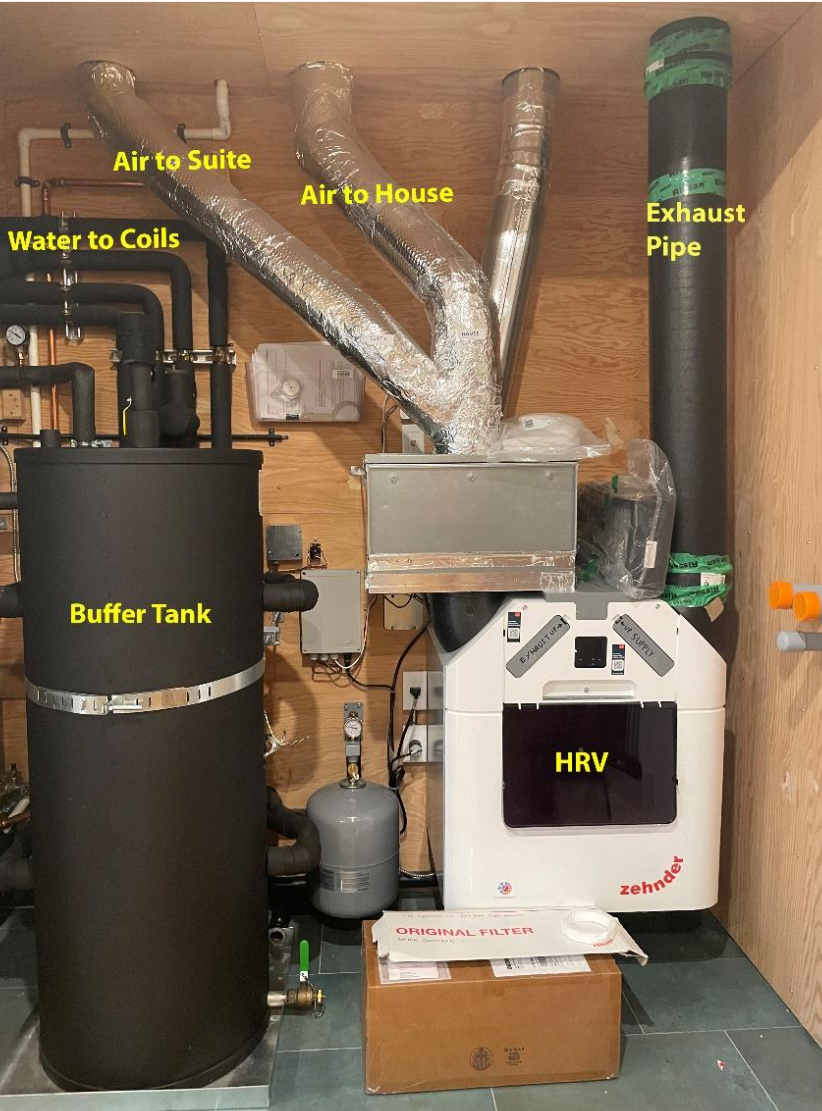
Our ‘engine room’ - it’s complicated. Photo: Claudia Cornwall
When Gordon, my husband, and I moved into our new passive house, it was not a turnkey situation where we waltzed in and found everything worked perfectly. We discovered that the heating system needed adjustment. It was complicated, with many parts.
We have an Arctic heat pump rated for-25 °C. It’s connected to a buffer tank inside, which acts as a reservoir of heat in winter and cold in summer. The point of having a tank is to spare the heat pump. It doesn’t have to work as hard or as often to keep the house comfortable.
The buffer tank feeds two sets of hydronic coils, one for the main part of the house and one for the suite. Each dwelling has its own thermostat. When the thermostat in either dwelling calls for warmth, heated water from the buffer tank flows to the hydronic coils for that dwelling. When a thermostat calls for cooling in summer, cold water flows.
Bringing air into the mix
A heat recovery ventilation (HRV) unit continuously swaps stale indoor air with fresh outdoor air. In winter, it cleverly recovers heat from outgoing warm air to preheat the incoming cold air, making ventilation energy-efficient. (In summer, the heat recovery ventilator recovers coolness from the outgoing air.)
After the incoming air passes through the heat recovery ventilation unit, a fan blows it over the hydronic coils where it’s further warmed (or cooled) and distributed through the house via ducts.
A snag
We discovered that our heat pump would not heat the buffer tank to more than 50 or 51 degrees C. This was a built-in design decision. This limit is fairly common. Heating water to higher temperatures requires more electricity, which significantly reduces the heat pump's efficiency and may shorten the lifespan of the system. Higher temperature heat pumps do exist, but so far, are more expensive. Mostly, the 50-degree limit was fine, but in the colder months, we wanted a little more heat in the house than we were getting. We couldn’t increase the buffer tank temperature. So, what could we do?
We started tweaking
There are two ways of getting the hydronic coils to transfer more heat to the air. You can increase the airflow over the coils, allowing the air to pick up more heat. Or you can increase the flow of water through the coils, allowing it to release more heat. We did both.
We had a boost function that sped up the fan's airflow over the hydronic coils. Our heat pump supplier told us we could tie the boost to the thermostat so it would run whenever the thermostat in the house called for heat.
Gordon also learned he could accelerate the pump sending water through the hydronic coils using an app on his phone. And he found a valve that was slowing down the water flow. We got our supplier to change it out. These modifications were helpful. But it turned out we needed to do more.
A rude awakening
In mid-January 2024, we had a sudden cold snap. Temperatures in North Vancouver plummeted to -13 °C.
Gordon and I were in the living room doing our morning exercises when we heard a loud whistling sound coming from above a sliding glass door on the south side of the house. We felt around the top of the door and realized cold air was pouring in. We used an anemometer to test the wind speed.
It was 14 km/h.
The temperature in the house had dropped to 15 degrees C. Hmm…Gordon bought a small portable baseboard heater to keep us warm while we pondered the problem.
The blower test had shown that the house was well sealed. In fact, the house had passed the test with flying colours. Despite the cold temperatures and wind chill, our pump continued to heat the tank to its max—50-51 degrees. What was wrong?
We have a stationary bicycle next to the HRV unit. The morning after we discovered the air leak, I was peddling away when I noticed a message on the HRV unit’s screen: “Frost Protection Mode On.” What is that?” I asked Gordon.
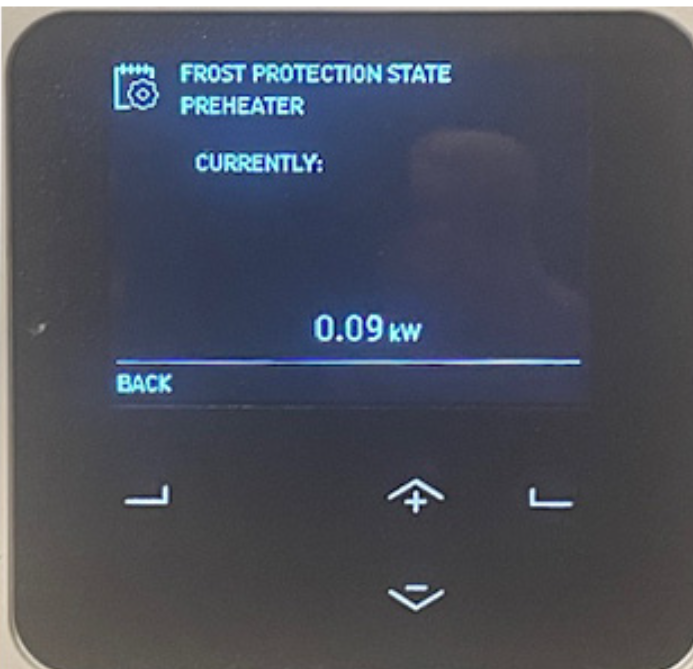
Frost Protection On Photo: Claudia Cornwall
He didn’t know either and dove into the Internet to find out. Normally, the airflow into the house via the HRV unit is in balance with the air flow going out. The balance is maintained by two fans rotating at the same speed. But when temperatures drop below freezing, our HRV unit began to reduce the flow of air coming in to prevent the unit from freezing up. This is “Frost Protection Mode.” It created significant negative pressure in the house. The outside air would come in through any little crack. We checked all our windows and doors with the anemometer. Only the sliding door on the south side was a problem.
Fortunately, Gordon found a solution — a relatively inexpensive preheater (around $400). When temperatures drop, it heats the incoming air to just over freezing and the HRV doesn’t slow down the supply fan. Frost protection mode is not triggered. The air flow in the exhaust and supply ducts remain balanced and the cold air stops rushing in.
We ordered the pre-heater and, since then, have had no problems with temperatures below zero. Recently, when we hit -2 C, the preheater came on. This screenshot shows that we are using 0.09 kW to bring the incoming air up to 0 C. If we had to run the preheater for an extended period, say 12 hours, it would cost us less than $2.00. After the preheater brings the air to 0 C, the heat recovery system and heat pump take over to make the house comfortable.
Minimally invasive surgery
Our house was now warm enough upstairs, where we had three air supply vents for our office and two bedrooms, one per room. Downstairs, our suite with two modest rooms and two supply vents and our library with one vent were all comfortable. The problem was our ‘great’ room with a kitchen, living, and dining space and just one supply vent. Could anything be done about this in a finished house?
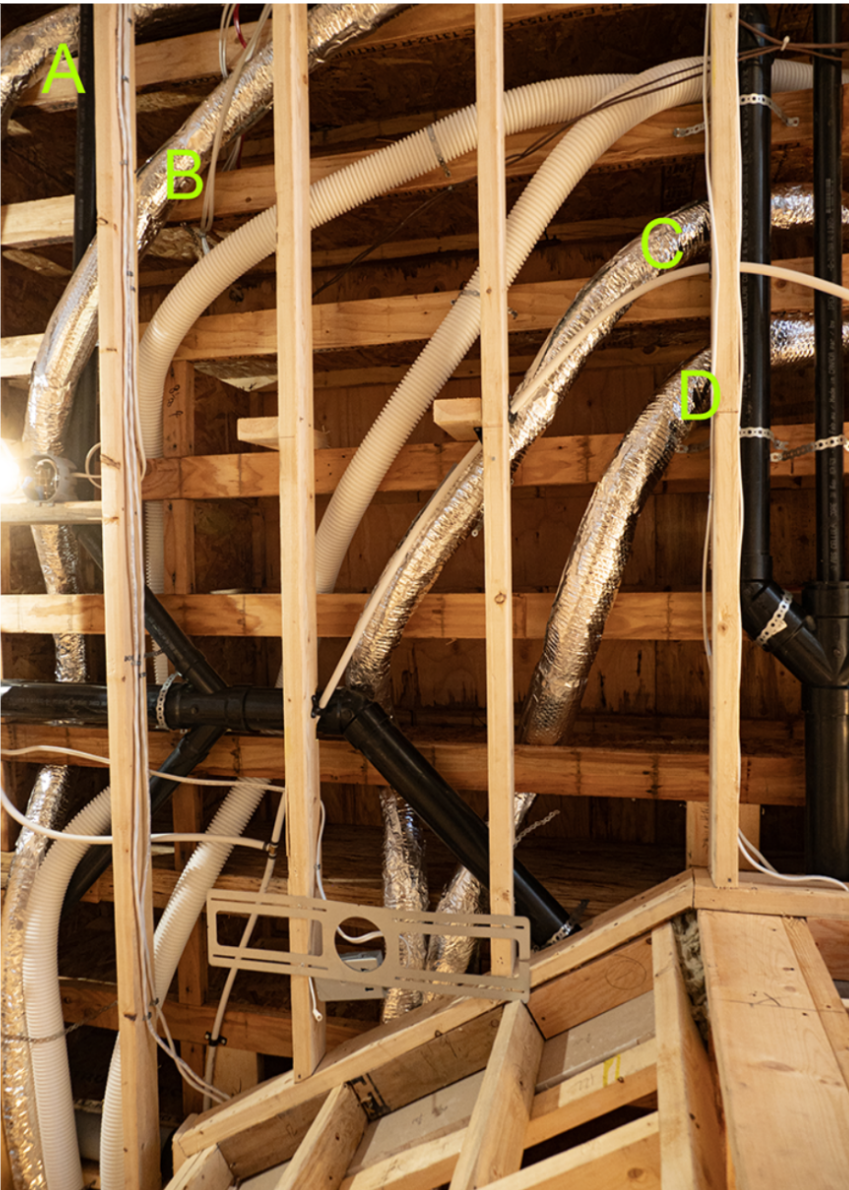
Ducts A and B, flowing upstairs were candidates for diversion Photo: Claudia Cornwall
Gordon had an idea
Each supply vent had two flexible ducts. Following the advice of our heat pump supplier, we had already tried closing two of the upstairs ducts to force more warm air downstairs where it was needed. This was an improvement, but still not good enough. Gordon proposed minimally invasive surgery—making a small incision in the ceiling downstairs and diverting one of the ducts that was going upstairs, to vent downstairs instead. While the house was being built, he had taken copious pictures, including one that documented the location of the ducts. When Gordon showed his photo to our builder, he agreed the operation was feasible. He sent a craftsman over, who, in about three hours, was able to divert the duct and install a new vent for it, leaving no noticeable scars on our lovely yellow cedar ceiling. We were now warmer and happier.
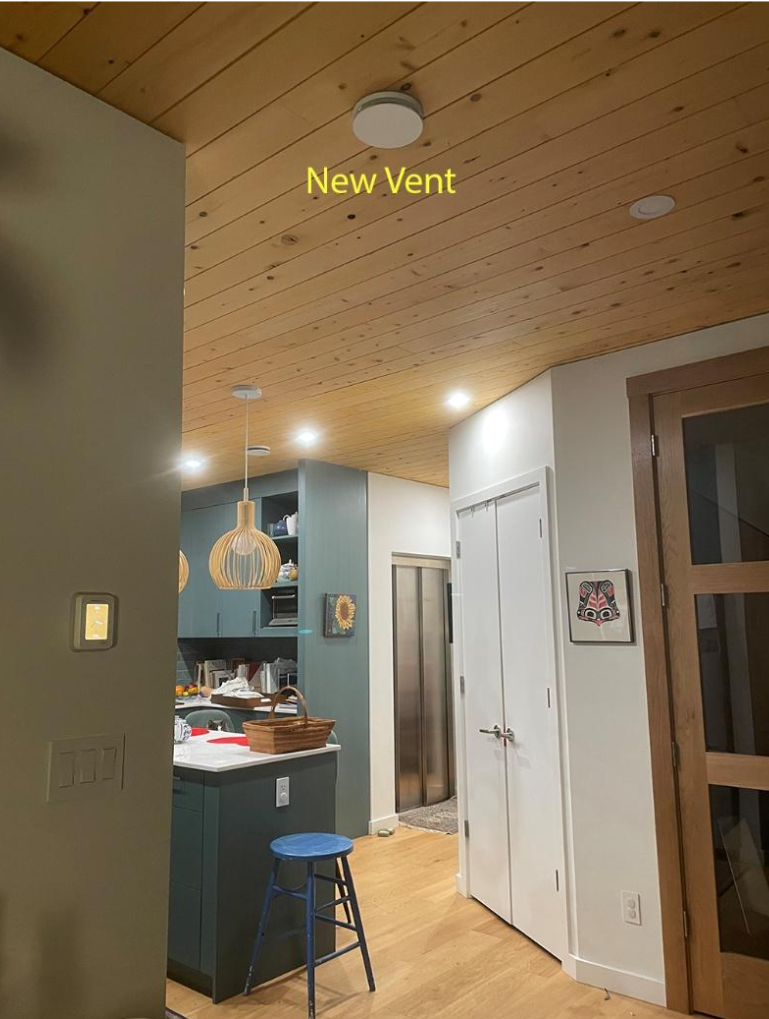
The new vent delivers warm air downstairs. Photo: Claudia Cornwall
The shoulder seasons and summer
For long periods, in the spring and fall, we didn’t need the heat pump for either heating or cooling. What about cooling in the summer? Since moving into our house in April of 2023, we have hardly used the heat pump for cooling. Our cedar trees and wide overhangs on the south side of the house provide ample shade. We have large windows and sliding doors that we can open to get a nice cross draft going. But we are still grateful to have the cooling option—especially for days when the air is smoky and we don’t want to open the windows. I remember sweltering in the smoky summer of 2021. That year, six hundred people died in B.C. due to the heat. When I was growing up in Vancouver, no one had air conditioning in their house. But unfortunately, it is a necessity today.
Is the buffer tank a good idea? The jury is still out.
My son retrofitted his house in Smithers with a heat pump. He used the network of ducts installed for a gas furnace. He didn’t install a buffer tank and was quite satisfied with the results. Look here for information about the pros and cons of buffer tanks.
What about a ductless system? My daughter, who lives in Vancouver, wanted to cool an upstairs bedroom in her house. She went with a mini-split in that bedroom and an outdoor heat pump. Mini-splits are box-like units that can be placed wherever you need heating or cooling. They don’t require ducts and are often used for retro-fits in houses that don’t have them.
BC Hydro has a lot of information about heat pumps, ducted vs ductless systems, and rebates for purchasing heat pumps for condos as well as detached houses.
My father used to quote Shakespeare and say, “All’s well that ends well.” We had some struggles, but we are now pleased with our home's performance. All is well.
In the next installment, I will be interviewing Bruce Murdoch, a B.C, high-performance house builder. He will argue in favour of the proposition that building a high-performance residence need not cost more than building a more conventional home.
This article is part our A Better House series:
If this story resonates with you, please forward this to a few friends, and suggest they join our email list. We're building a group of like-minded people who want to see the North Shore positively embrace and manage the many changes we face. Thanks, we really appreciate it.