Can missing middle housing ever be truly affordable on the North Shore?
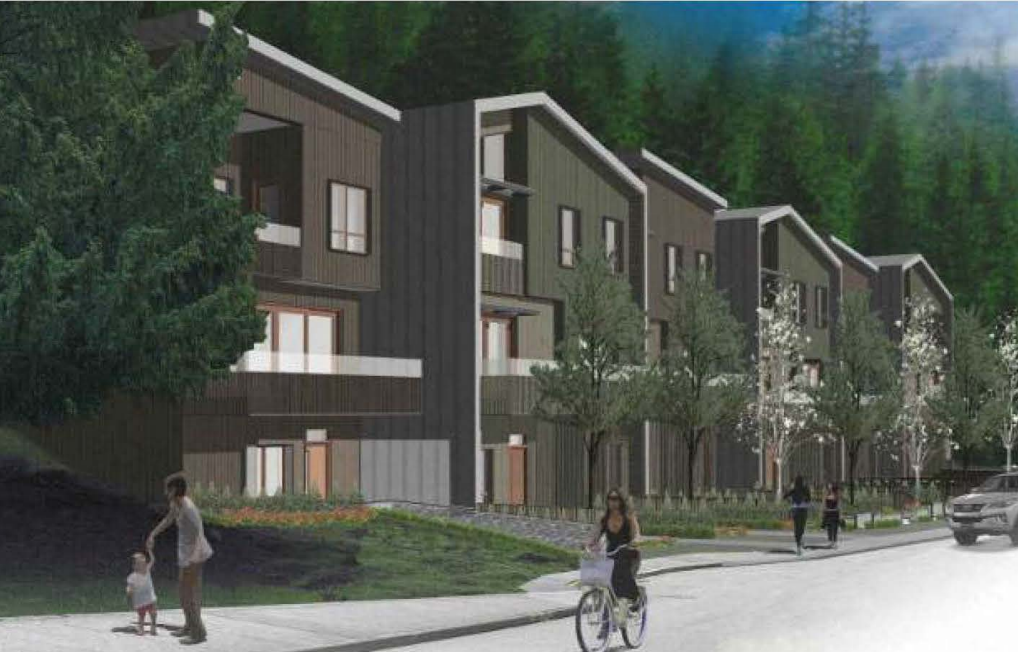
Gleneagles townhome proposal in West Vancouver would see 12 homes on 2 lots. Image: staff report
A month ago, I set out to determine how we could make ground-oriented housing on the Shore actually affordable.
What I found: we can make ground-oriented homes more affordable than existing single-family homes. However, we can’t make them truly affordable without significantly increasing density beyond 1 FSR and altering the number of homes (only for non-profit builders). Here’s part one of how I came to this conclusion.
Building more homes for families: the economics
Let’s say I’m a developer in the City of North Vancouver. The new zoning rules mean I can buy a lot and put four homes on it with a floor space ratio of .85. On a 6,000-square-foot lot, I can build a total of 5,100 square feet if I max out the floor space ratio. 5,100 divided by 4 is 1,275 square feet. Each of the four homes could be up to 1,275 square feet. That’s great! Plenty of space for four families, where only one lived before. That’s the good news for people looking to own.
The not-so-great news? To make any money (remember I’m a small commercial developer), I need to sell those four homes for $1,565,105 each. That’s the price at which I can make a 15% profit, which is what I need to cushion risks and make the project viable for me in the first place.
What happens if I could get more floor space? Say 1 instead of .85. Well, I can still only build four bigger units (1,500 sq ft) that would sell for more (~1.72M) and I can make 15%. That’s 15% of a bigger number, so I make more. But it doesn’t make the homes more affordable.
So, the new rules do mean more homes in a different format, potentially more attractive to families with kids than apartments or condos. Are they going to be cheaper than a single detached house? Yes, in the main. A quick search on REW shows 20 detached houses in North Vancouver selling for under $1.5M. Most of them are either knockdowns, hazard properties or are right next to the highway. Most single-family homes in the city is between selling $1.8M -$2.5M for older homes and over $4M for a new one with a suite and a coach house.
Okay, so what about affordability?
People who decry the plan to put more housing on a single lot say, ‘but it's not really affordable.’ They’re right. By truly affordable, I mean a two-bedroom or more home with a rent of $720/month or a home with a purchase price of $350,000. This definition is based on a one-income household making minimum wage. There is a way to create housing this cheap, which I’ll discuss in another post, but not at 0.85, 1, or even 1.2 FSR.
There’s still the fact that a $1.5M fourplex is more affordable than a $2.7M house or even a duplex, so we should still build them.
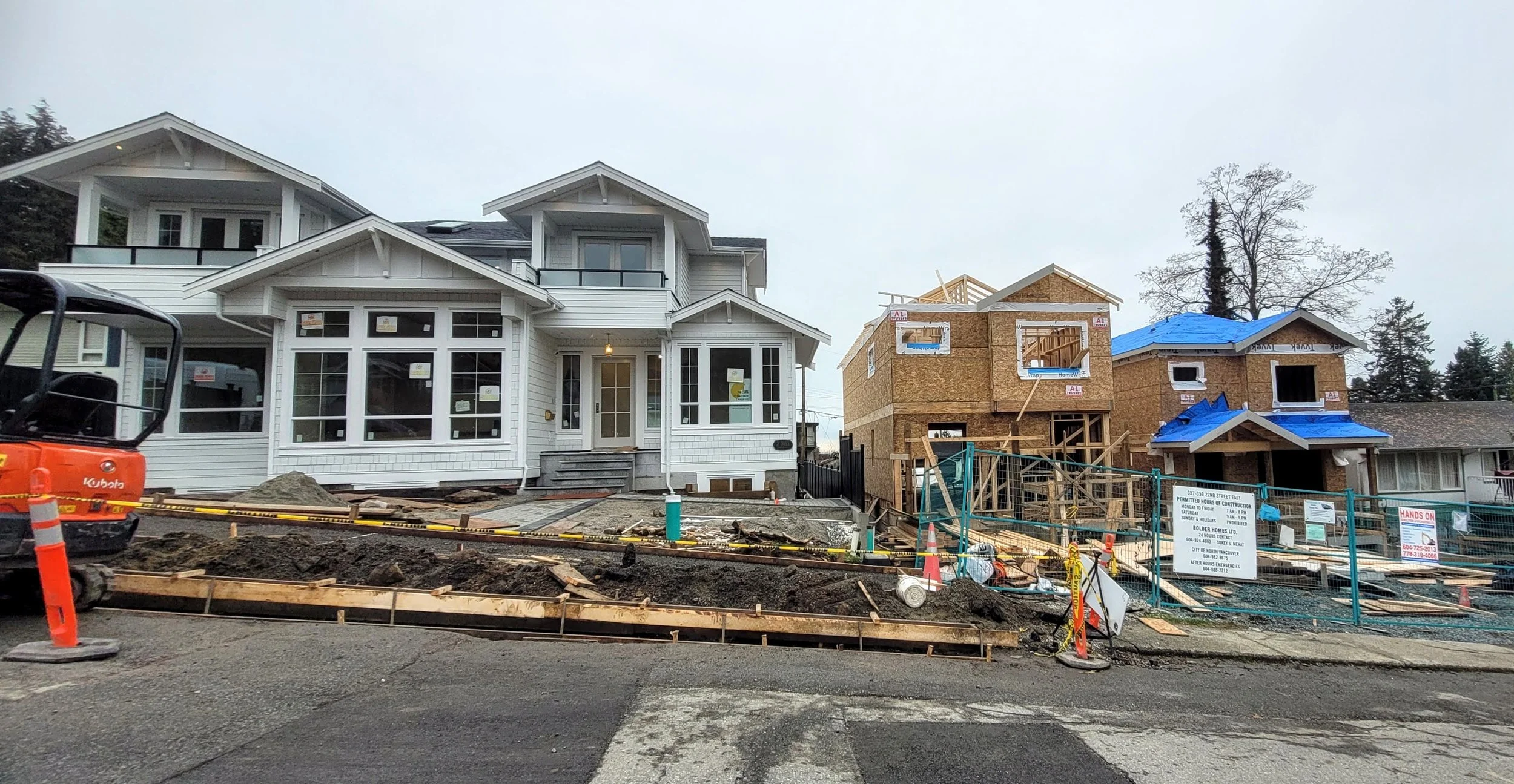
The house on the left is a single-family home with a suite in the bottom and a coach house. It’s on the market now for $4.6M. The site next door was a single-family home split into two lots, each with a single-family home (no suites). Guessing each will sell for ~$2.7M. Down one block on the same street new duplexes are selling for $2.5M. Photo: Heather Drugge
Will sixplexes improve affordability? Same lot at FSR = 1.0 = six 1,000 square foot homes that will sell for ~$1.2M. So, yes. Sixplexes will produce more homes at a lower price point than fourplexes. Makes sense, because the land cost is spread across six homes, not just four. It's still worth building both even if they’re not truly affordable.
Why this really matters
If ordinary people can’t live here, the obvious problem is where do we get people to work in retail, restaurants, and childcare. Teachers, nurses and protective services workers struggle to live here. We’ve all heard this and have probably felt the impact in one way or another.
But there’s another, more problematic consequence
The housing crisis is producing something the North Shore has never really seen before: a generation of voters who feel the system is working against them. Housing is now a trust issue. This is the real concern. It’s not just affordability. It’s credibility. It’s a test of whether existing or even modified systems can deliver results that matter.
So far, we are failing.
Read part two next month to find out how we can build truly affordable homes.
If this story resonates with you, please forward this to a few friends, and suggest they join our email list. We're building a group of like-minded people who want to see the North Shore positively embrace and manage the many changes we face. Thanks, we really appreciate it.