

A Better House: Harvesting solar energy in Canyon Heights
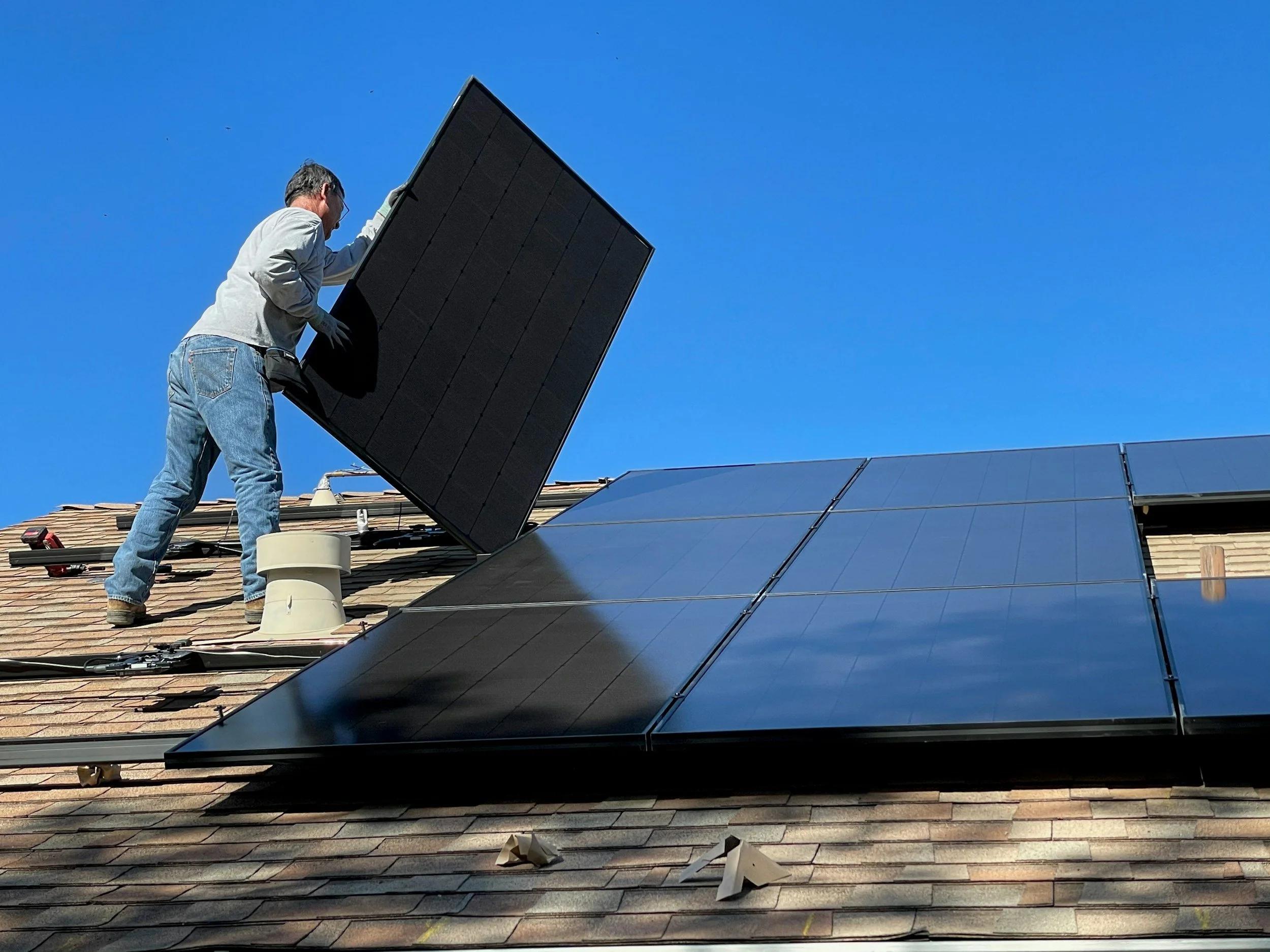
Photo: Unsplash
In 2023, the Cornwalls moved into their new passive house in Canyon Heights. Read the first installment of the Better House series about the build here.
Our new passive house was designed to reduce energy consumption. It has premium insulation, airtight construction, triple-glazed windows, and controlled ventilation. We went one step further and installed 24 solar panels on our roof. We wanted to see how much electricity we could generate on our property to offset the energy our house consumes. We signed up for what BC Hydro originally called the Net Metering program and later named the Self Generation program. The program allows homeowners to accumulate credit in the summer when they generate an energy surplus. They can apply this credit to the bills they receive later in the year when production is lower.
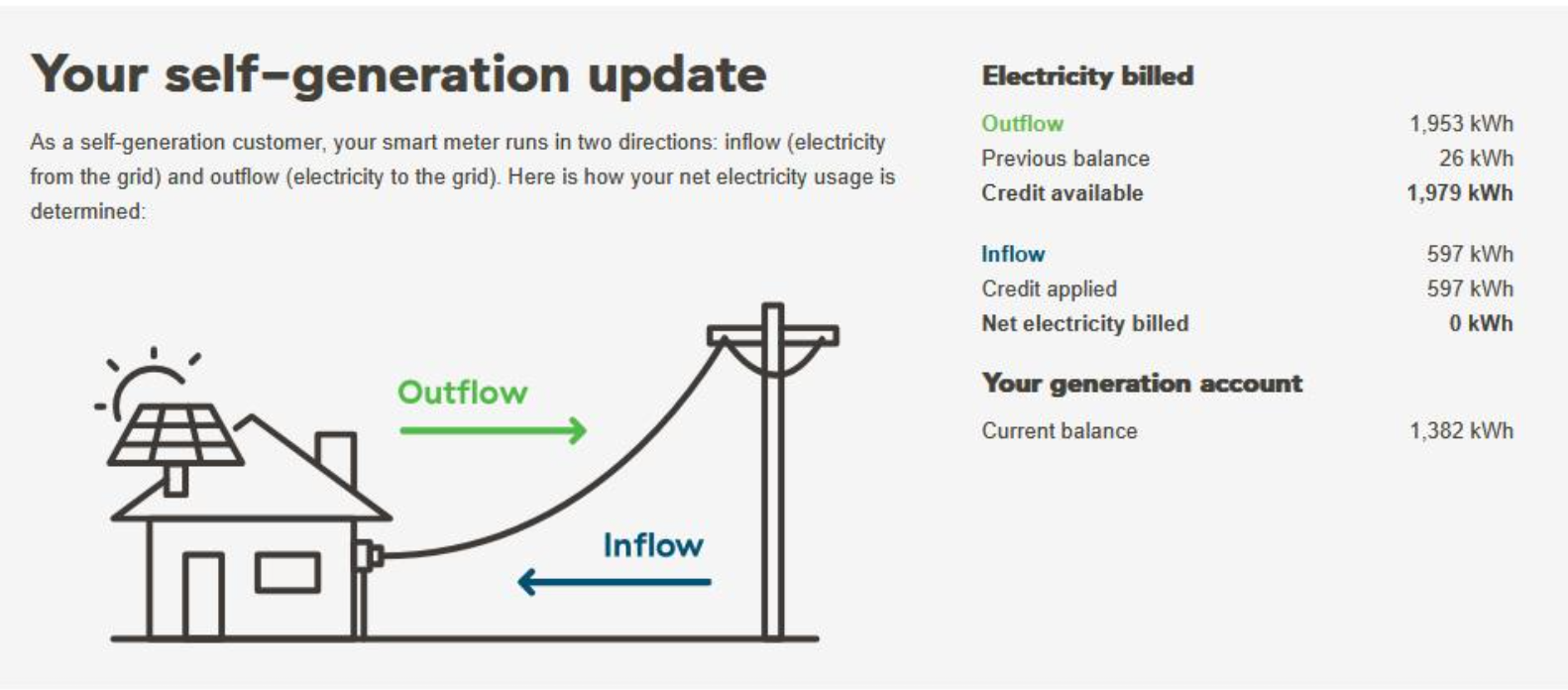
July 2025 Hydro bill
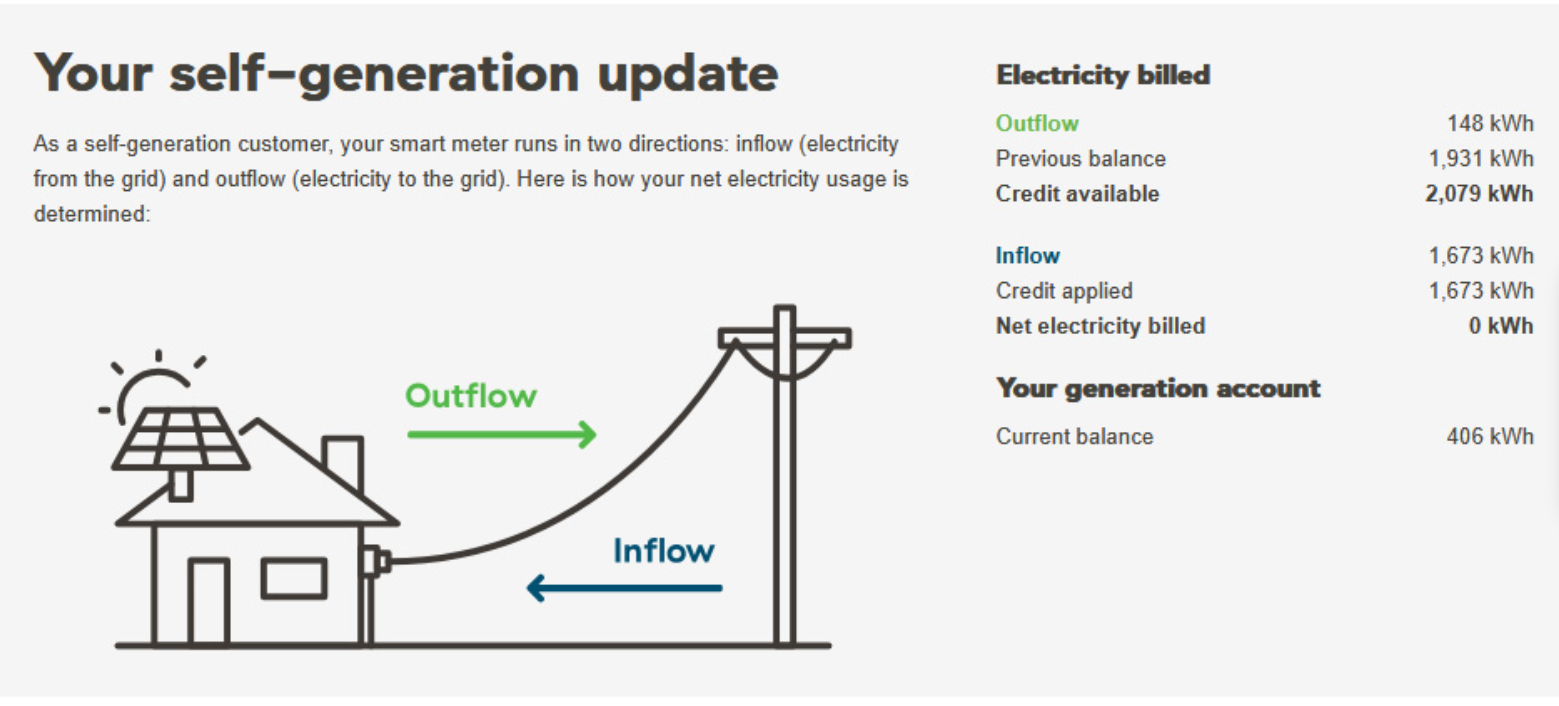
November 2025 Hydro bill
According to our bill for July 2025, outflow, our export to the grid, was 1953 kWh. Our inflow, what we imported, was 597 kWh. We had a net credit of 1382 kWh.
In November, the outflow was 148 kWh, and the inflow from the grid was 1673 kWh. Our accumulated credit from the summer was applied, leaving us with no charge for electricity in November, and a remaining credit of 406 KWh to be applied to the next bill.
Over all of 2025, we used a total of 12,961 kWh, and generated 7,500 kWh. Our net import from the grid was 5,461 kWh and covered all our energy needs. Our old house, used 67 gigajoules of gas per year and drew ~10,000 kWh of electricity from the grid. Even though our new home is totally electric, is larger than the old house, and accommodates a tenant, it needs less grid electricity than our old house and no gas at all.
The Fraser Institute and the Energy Futures Institute have argued that increased electrification isn’t a good idea because BC’s electricity grid isn’t up to the task and will be overwhelmed by demand.. Our experience is evidence to the contrary. Rooftop solar can help reduce the demand. By 2025, 12,000 households were on the self generation program in BC, producing mostly rooftop solar, on average 7,700 kWh per year, or 92.4 GWh in total. BC Hydro is forecasting rooftop solar to increase by a factor of five by 2040. Canada in general has much more capacity for solar than many people realize. A July 2024 report from Natural Resources Canada estimates that we could generate 76% of the energy requirements of our buildings, both residential and commercial with local solar panels. At the moment, solar only accounts for 1.7% of our electricity generation.
No roof? No problem
Balcony solar, an option for the millions of people who don’t own a roof, is rapidly gaining popularity in Europe.
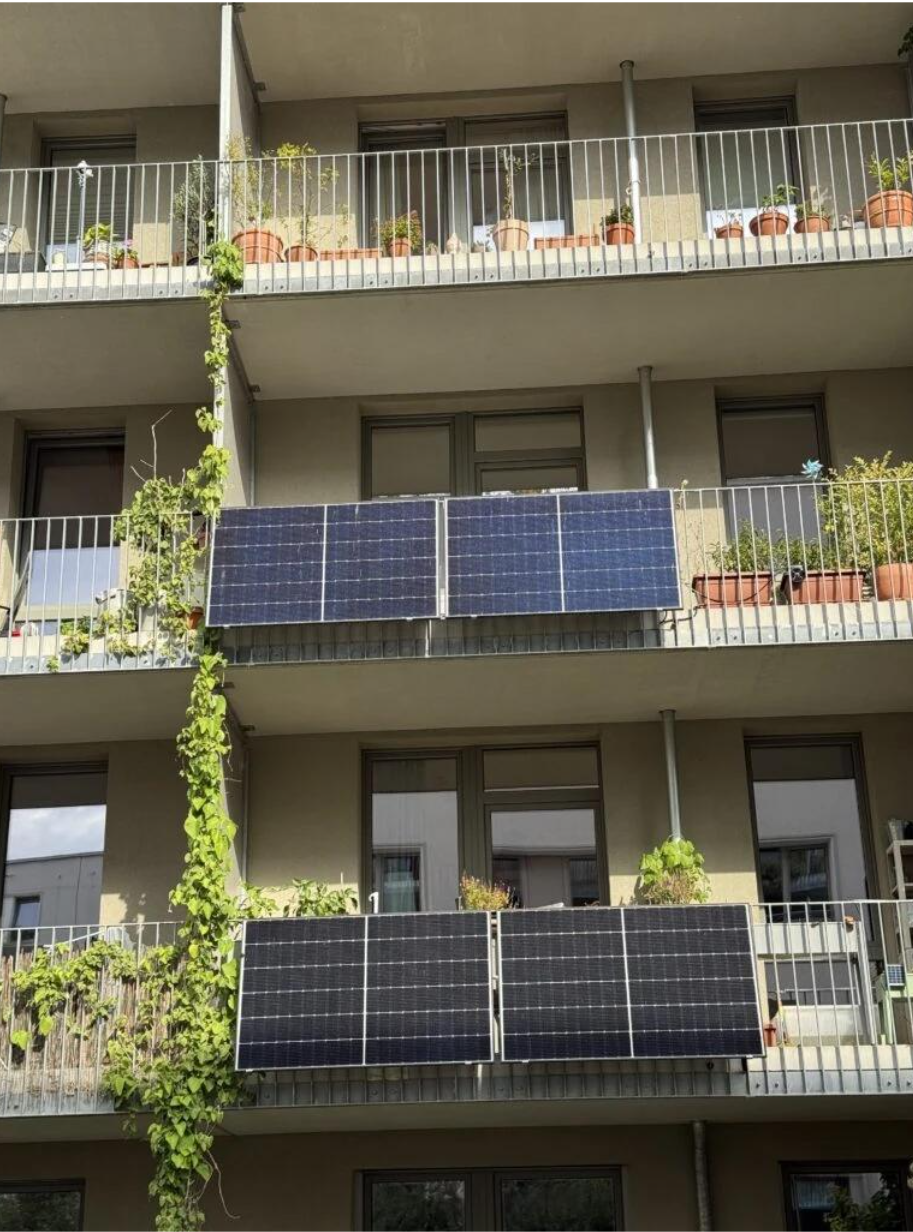
Balcony solar panels at Möckernkiez, a housing complex in Berlin, help the housing estate generate more of its own energy, alongside rooftop solar and biogas. Photo credit: Peter Yeung.
If you are interested in learning more about this, Balcony Solar Panels: Which Type To Choose And How to Use it in Canada? is a good place to start.
Energy-efficient appliances and heating
Using more efficient appliances can also reduce demand. In our old house, we had a gas furnace and electric baseboards for space heating. Now we have a heat pump, far more efficient than either. Baseboards, in particular, are energy hogs. Reality Check, a February 2025 report from Clean Energy Canada states that if BC households using baseboard heating changed over to heat pumps, the province’s demand for electricity would shrink by 5%. BC’s consumption of electricity currently totals 58 TWh (Terawatt hours); 5% of that is 2.9 TWh or 2900 GWh (Gigawatt hours)—3/5 of the capacity of Site C.
I’d had a gas stove in our old house, and enjoyed it. But for our new house, we chose an electric range with an induction cooktop. The cooktop transfers about 85% of energy to the food, while gas cooktops transfer only 40% to the food; they lose 60% to the air due to open flames. Cooking with induction is faster than gas, and consumes less energy. It is healthier too. Burning natural gas generates high levels of nitrogen oxides, which are linked to asthma, especially in children. If you are curious about what it’s like to cook with induction, you can do what we did—try a portable induction hotplate first. You can buy one for $100 or less.
Tree trade-off considerations
Is there any way that our house could draw even less from the grid? Almost certainly. On the southeast side of the property, we have five cedar trees that cast shade on some of our solar panels. Should we consider removing them?
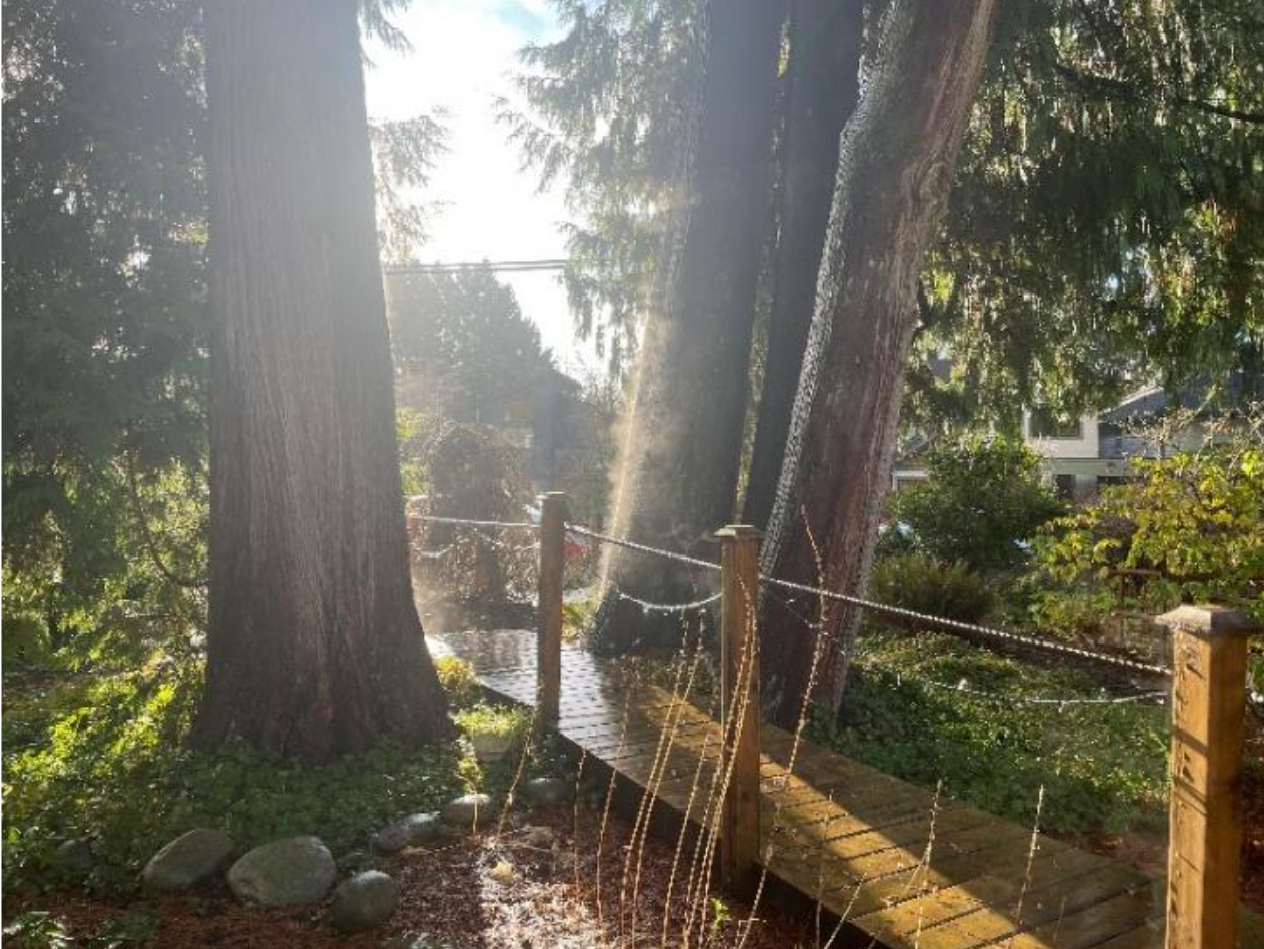
Cedars hugging our boardwalk. Photo: Claudia Cornwall
Our cedars are lovely and healthy; they were probably saplings when the neighbourhood was developed, in the late 50’s. They exude many healthy aerosols, such as cedrol, which has been shown to lower anxiety, decrease blood pressure and breathing rates, and act as a sedative to improve sleep.
The trees sequester tonnes of carbon
I measured the circumference of each at 1.3 meters, calculated their diameters, and, using a calculator from Resources Canada, determined their biomass. The calculator deduced the weights of the bark, branches, foliage, and stem wood. Altogether, the cedars contain 13,885 tonnes of biomass, roughly half of it, carbon—6.9 tonnes. To store this much carbon, the trees had pulled 25.5 tonnes of CO2 from the atmosphere. They compensated for the carbon dioxide emissions from one conventional gas-powered car for five years.
Of course, it is not a simple matter to take out a mature tree in the District of North Vancouver. The district has a number of regulations that protect trees and enhance the district’s urban tree canopy. If you remove a tree and reduce the property's canopy cover to below 20%, you are required to replant trees as per the bylaw. With permission, we cut some trees on the west side of the property, but by keeping the cedars in front, as well as a Western maple and another cedar, in the back, our canopy cover remained within the district’s benchmark. No further tree planting was required and some expense was spared. (If you are interested in adding to your stock of trees, you might want to look into the Urban Tree Canopy Festival, a program that gives away free trees and shrubs. Metro Vancouver has a goal of creating a 40% tree canopy by 2050.
Cooling in summer months
Our trees help to keep the house cool in summer. Because of them, we don’t need to call on the heat pump for its cooling function as much. But they also shade the solar panels. We have an app that tracks what the solar system is generating in real time, day by day. These two screen shots give you an idea of how much the panels are shaded.
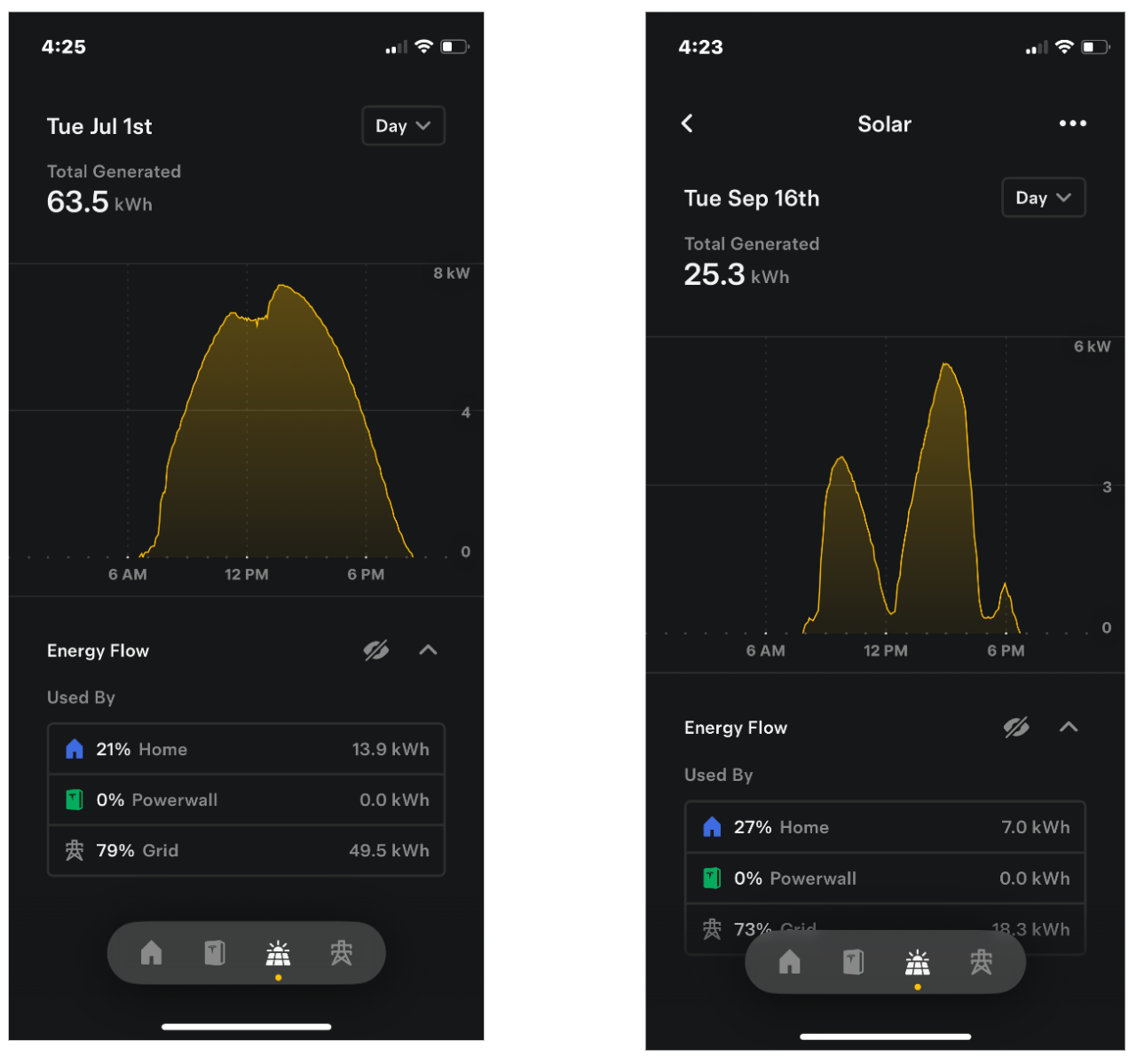
July 1, 2025 Solar Generation September 16, 2025 Solar Generation
The screenshot on the left from July 1 depicts a nice sunny day with great solar generation, 63.5 kWh coming in. The sun was high in the sky. The curve traces the path of solar generation throughout the day. At noon, when the trees cast a little shade on the panels, you can see a small “bite” taken out of the curve. Two and a half months later, on September 16, it was also a nice, sunny day. But the sun was lower in the sky, and the “bite” on the curve is much more pronounced, showing more shading. (These graphs are auto-scaled. The vertical axis on the left one goes to 8 kWh, the one on the right goes to 6 kWh.)
So, how many kWh did we save when we didn’t have to use the air cooling function on our heat pump? How many kWh of generation did we lose because the panels were shaded? I was not sure how to answer these questions. We weren’t seriously tempted to remove our trees, but looking at the graphs again, I’m inspired to think about some thoughtful pruning.
We did discover some other tweaks that improved our system's efficiency—and our comfort. More about that in the next installment.
This article is part our A Better House series:
If this story resonates with you, please forward this to a few friends and suggest they join our email list. We're building a group of like-minded people who want to see the North Shore positively embrace and manage the many changes we face. Thanks, we really appreciate it.