

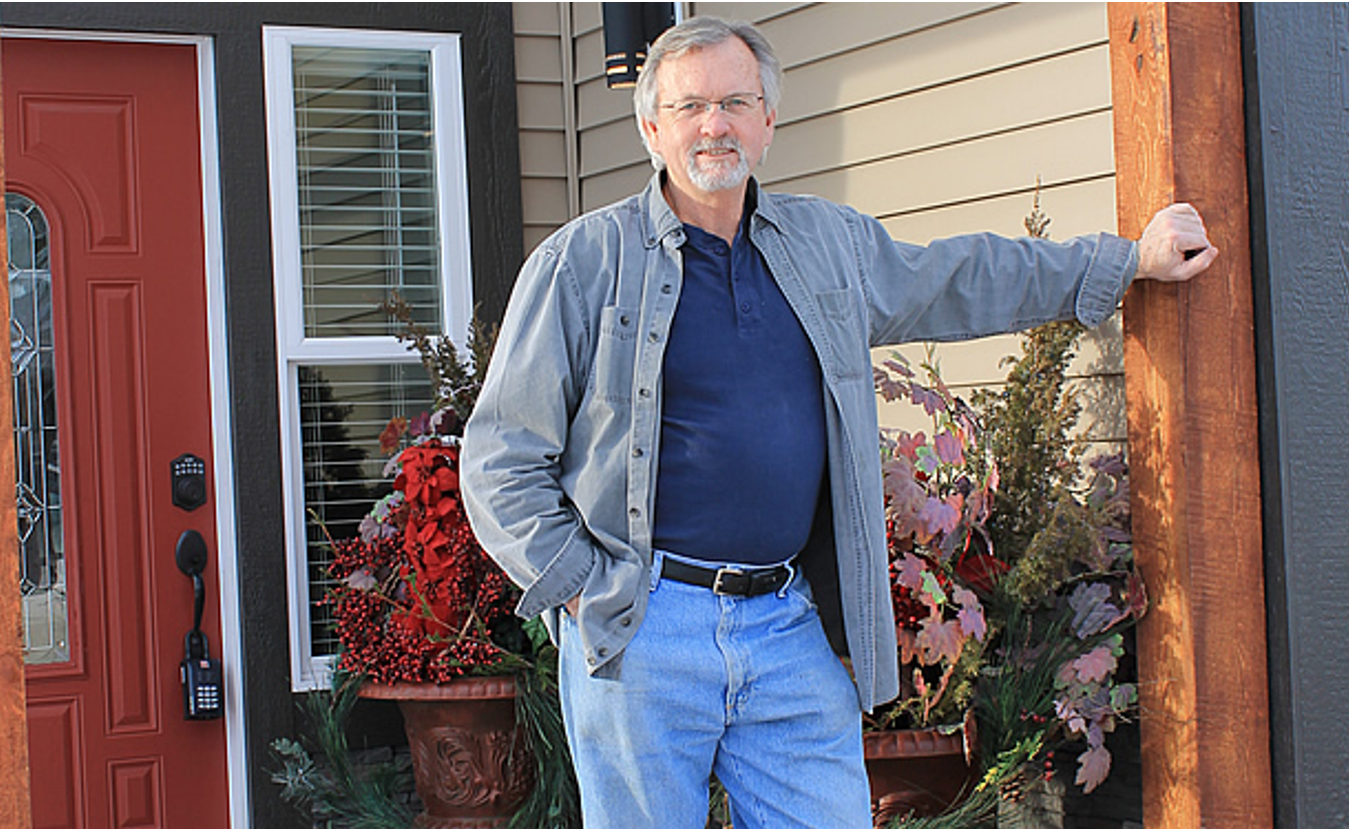
Bruce Murdoch started building houses in the early ’90s, and founded K-Country Homes in Cranbrook, B.C. in 2007. He’s a leader in the field of decarbonization, high-performance homebuilding, and affordability. He finds cost savings by carefully planning the shapes and size of his buildings and also by using heat pumps which can do double duty—heat and cool, instead of installing furnaces plus air conditioners. Photo: Bruce Murdoch
Often, when people think about high-performance homes, they associate them with a high price tag. Bruce Murdoch’s houses run counter to this stereotype. He started building houses in the early ’90s, and founded K-Country Homes in Cranbrook, B.C. in 2007. He’s a leader in decarbonization, high-performance homebuilding, and affordability. He finds cost savings by carefully planning the shapes and size of buildings and by using heat pumps which can do double duty—heat and cool, instead of installing furnaces plus air conditioners.
I was intrigued. I knew that the built environment is still the third largest source of carbon emissions in Canada—around 13% of the total, or 89 Mt of C02 annually. Obviously, the more we can do to make affordable, low-emission buildings, the faster we can drive change.
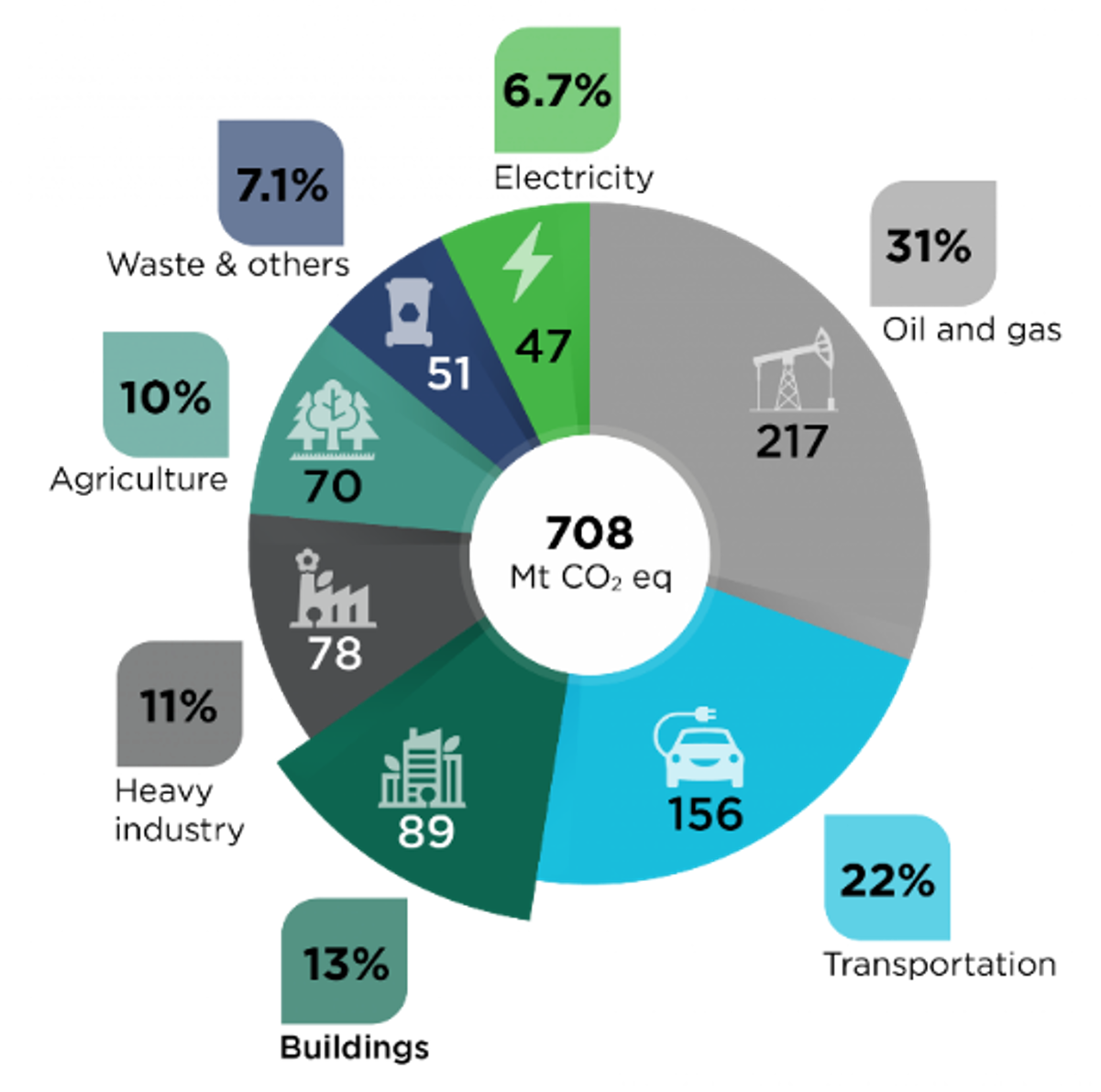
Natural Resources Canada: The Breakdown of Canada’s greenhouse gas emissions by economic sector (2022)
Bruce and I met on Zoom for an interview. We started by talking about Step Codes because these are a measure of performance. In BC we have two codes—The Energy Step Code and the Zero Carbon Step Code (ZCSC). The province has mandated that by 2026, residential houses and townhomes must meet Energy Step Code Step 3 plus Zero Carbon Step Code EL-1. All the municipalities on the North Shore require builders to meet higher standards. For example, the District of North Vancouver now requires that houses be Energy Step Code 4 plus Zero Carbon Step Code EL 3 or Energy Step Code 5 plus Zero Carbon Step Code EL-1. Click here for details about the rules for District of North Vancouver, the City of North Vancouver and West Vancouver.
Claudia: Why do we have two step codes?
Bruce: The main purpose of both step codes is to reduce emissions in homes. The Zero-Carbon Step Code is relatively new and the Energy Step Code has been around for over a decade. The Energy Step Code is all about energy efficiency. It has nothing to do with the fuel. It can be electricity, can be gas, can be anything. All we're trying to do is make the home require less energy. On the other hand, the Zero-Carbon Step Code is all about fuel. It's all about electrifying.
Technology has changed. Heat pumps, hot-water heat pumps, induction stoves, and heat-pump dryers are now affordable. It's very easy to get to zero carbon in a house by just electrifying it. Once the government realized that electrification is now possible right across the province, they developed the Zero-Carbon step Code and said, “Well, let's try to switch over to electricity if we can.”
Claudia: I wanted to talk about a comparison you made between two houses you built. One was all-electric; the other was not. And you could show that going all-electric was, in fact, cheaper.
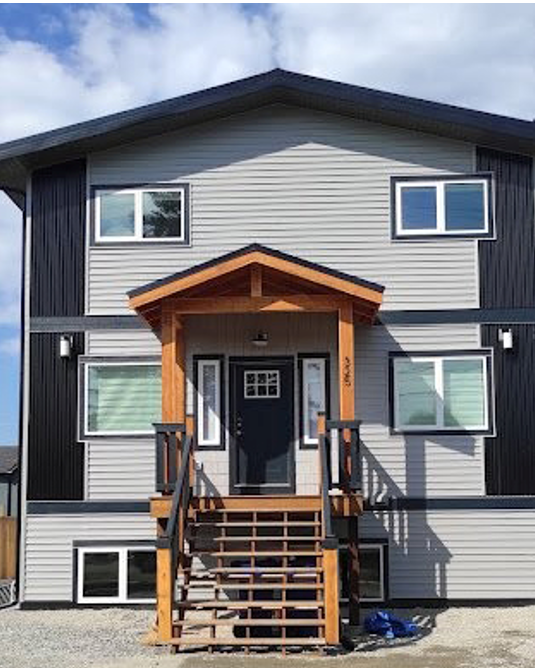
Bruce Murdoch's first all-electric house, built in Cranbrook in 2022. Photo: Bruce Murdoch
Bruce: The two homes weren't identical, but they were very, very similar in terms of square footage and all other specifications Here's the thing that has made all the difference to the economics. This year, every home has to have some air conditioning—at least one room that doesn't get over 26 degrees C. If you have to air condition one room, you're probably going to air condition the whole house. It doesn’t make a whole lot of difference to the cost. The comparison is no longer heat pump versus gas furnace. The comparison is now heat pump versus gas furnace plus air conditioning. The two quotes I had: one for a gas furnace plus air conditioning, about $28,000; for the heat pump only, about $24,000—about $4,000 cheaper to go with a ductless heat pump.
Claudia: What are your top tips for keeping costs down?
Bruce: It all starts with design. There’s more than just the heating, ventilation, and air conditioning equipment to consider when it comes to zero-emissions or high-efficiency. There are certain “affordable design principles” that will cut the cost of your building. They always, or almost always, align with energy efficiency. If you build a house affordably, you're going to have a more efficient house. It's automatic. I had a client in Kimberly who asked a couple of local builders to give her a price on a Step Code 5 house. She said, “Here's my budget--$600,000.” And they said, “We can only do Step Code 3 for $600,000.” So, she came to me and said, “Can you do it?” I said, “Well, give me a chance to look at the design.” I looked at the design, and not only did I find $50,000 in up-front savings, but I also made a much more efficient Step Code 5 house.
Claudia: How did you reduce the cost by that much?
Bruce: The two secondary bedrooms for the kids were huge. And my experience as a builder is that kids don't care what size the bedrooms are, as long as they have one. So, we saved some space on that. I think we probably saved about 150 square feet in those two bedrooms. Even at $200 a square foot, that's $30,000 right there. Another thing I do, for instance, is to make sure your washer and dryer are stacked, not side by side, because you'll save 15 square feet. Well, 15 square feet, even at $200, is $3,000. That pays for your washer and dryer. I made the house a little more square, a bunch of other things like that, and I wound up saving $50,000. I was able to upgrade the walls, and we went all electric.
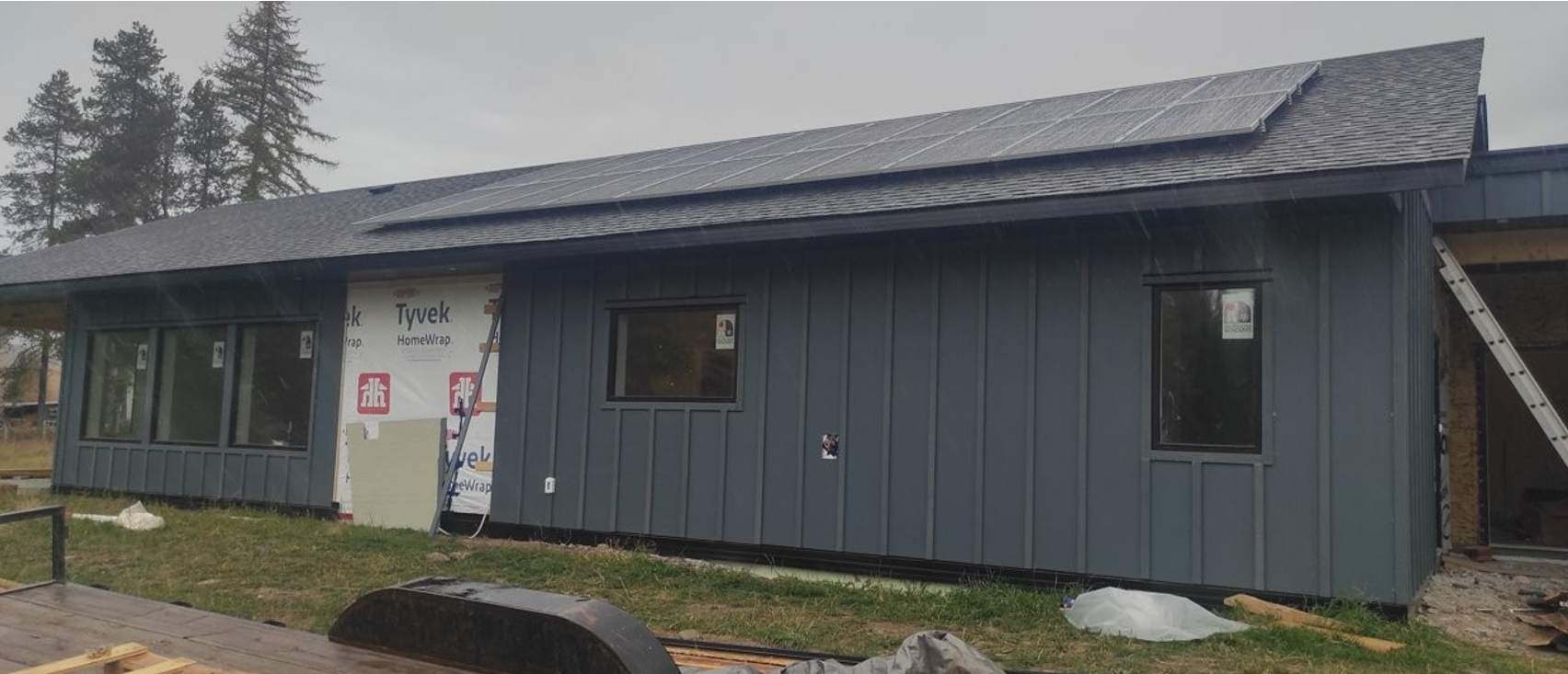
Bruce Murdoch”s Net Zero Home in Kimberley, BC, pictured under construction in 2024. Photo: Bruce Murdoch
Claudia: What are the most important things for keeping costs down?
Bruce: Number one is the shape of the building. Take a 20-foot by 80-foot house, 1,600 square feet. It costs a lot more than a 40-by-40-foot house, which also has 1,600 square feet. If you calculate the perimeter, the 20 by 80 house has a much larger perimeter than the 40 by 40 house. (200 feet compared to 160 feet). It’s more exposed to the outside elements. Not only is it more exposed from an energy-efficiency point of view, but because you've got more exterior walls, which are very expensive, it costs more. If you can take a rectangular house and make it square, not only will you have lower cost on walls, but you’ll have a more energy-efficient house because you're less exposed to the outside.
Claudia: That’s interesting - what else?
Bruce: Another one is bump-outs. Everybody loves walls bumped out here and there. But, each corner in a house adds costs and every time you bump out, you're exposing yourself to the elements. It costs more, and it's less efficient. If all your wall planes are straight, you could build your wall outside the envelope to make it look like it's got a bump, right? You can add the architectural features, but do it all on the outside of the envelope. Don't make it part of the envelope.
Claudia: What other features should we pay attention to?
Bruce: The shape of the building makes a massive difference to cost and energy efficiency. The other major item is windows. I say to people, “Be strategic with your windows. Get the most light out of them in the smallest possible way.” In other words, place it in the right spot where you’ll enjoy the natural light more, rather than having window walls. I've also found that going triple-glazed, especially if you're doing solar, is sometimes cheaper than double-glazed. I went triple-glazed on a house, for $1,800 extra. But I was able to compensate by eliminating two solar panels. So, it was a wash, but now you’ve got a house that's way more comfortable, because a triple-glazed window, when you're near it, is a lot more comfortable than a double-glazed window.
The fourth item is air tightness. We typically wrap the house in house wrap. But to get it air-tight, I would say it takes 8 to 15 person-hours to really button that. What's that cost? That's a few hundred dollars. And it's a huge difference in energy efficiency.
Claudia: In our house, we recover heat from the air. I wonder if you do heat recovery from water. Is that worthwhile? Like from the showers?
Bruce: I love it. It’s called drain-water heat recovery. It’s a big copper pipe that's wrapped in a copper tube. And it connects to your drain system. Instead of the black ABS pipe, you cut out five feet of it, and you put the copper tube in there. As the hot water comes down from the shower, it heats the pipe, which in turn heats the tubing containing cold water. The water is warm when it comes out. And that goes into the hot water tank. You wind up getting warm water going into the hot water tank. It’s so simple. And once it's installed, it's never a problem. I would recommend it. It’s about $600 for the pipe, and your plumber could do it when they do the build. It's very easy to plumb in. The one that I use is 5 feet long, and it recovers 53% of the heat from a shower. ( For more on this, see Natural Resources Canada).
Claudia: Is there anything else you would to like readers to know?
Bruce: On new buildings, I'm less concerned about the energy step code and pushing that. I'd rather see us go to the zero-carbon step code all the way to electric. I would just like to see more all-electric homes.
The other thing I'd love to see is a heat pump rental system for existing homes, because right now, even if it's got a rebate, not everybody has $8,000 or $10,000 laying around. If there was a rental system, that would remove the barrier of that upfront cost. This is being done successfully in New Brunswick, and they're installing a lot of heat pumps in New Brunswick compared to Nova Scotia next door. New Brunswick has the rental program, Nova Scotia doesn't. In BC, this would be the way for the government to make big headway on existing homes.
Claudia: We can't demolish all our houses and start new. So what energy improvements are possible as retrofits?
Bruce: A friend removed all the cedar siding from his house. He brought the house up to standard by making it air-tight, adding a whole bunch of insulation to the outside. Then he put his siding back on. It didn't cost him anything in siding, but it was a lot of labour. And he put in a heat pump at the same time. He brought his 100-year-old house up to modern standards, which is super.
If you’d like to learn more about building from Bruce, here are a couple of presentations he’s given.
For the Shuswap Climate Action Society: “Affordable Zero Carbon New Homes and Retrofits.”
For the Zero Emissions Information Centre (ZEIC) in Vancouver: “Advancing the BC Step Code in the East Kootenays”
For the East Kootenay Climate Hub: “Affordable Zero Carbon New Homes and Retrofits”
This article is part our A Better House series:
If this story resonates with you, please forward it to a few friends and suggest they join our email list. We're building a group of like-minded people who want to see the North Shore positively embrace and manage the many changes we face. Thanks, we really appreciate it.