

A Better House: the power of interconnectivity (and its rewards)
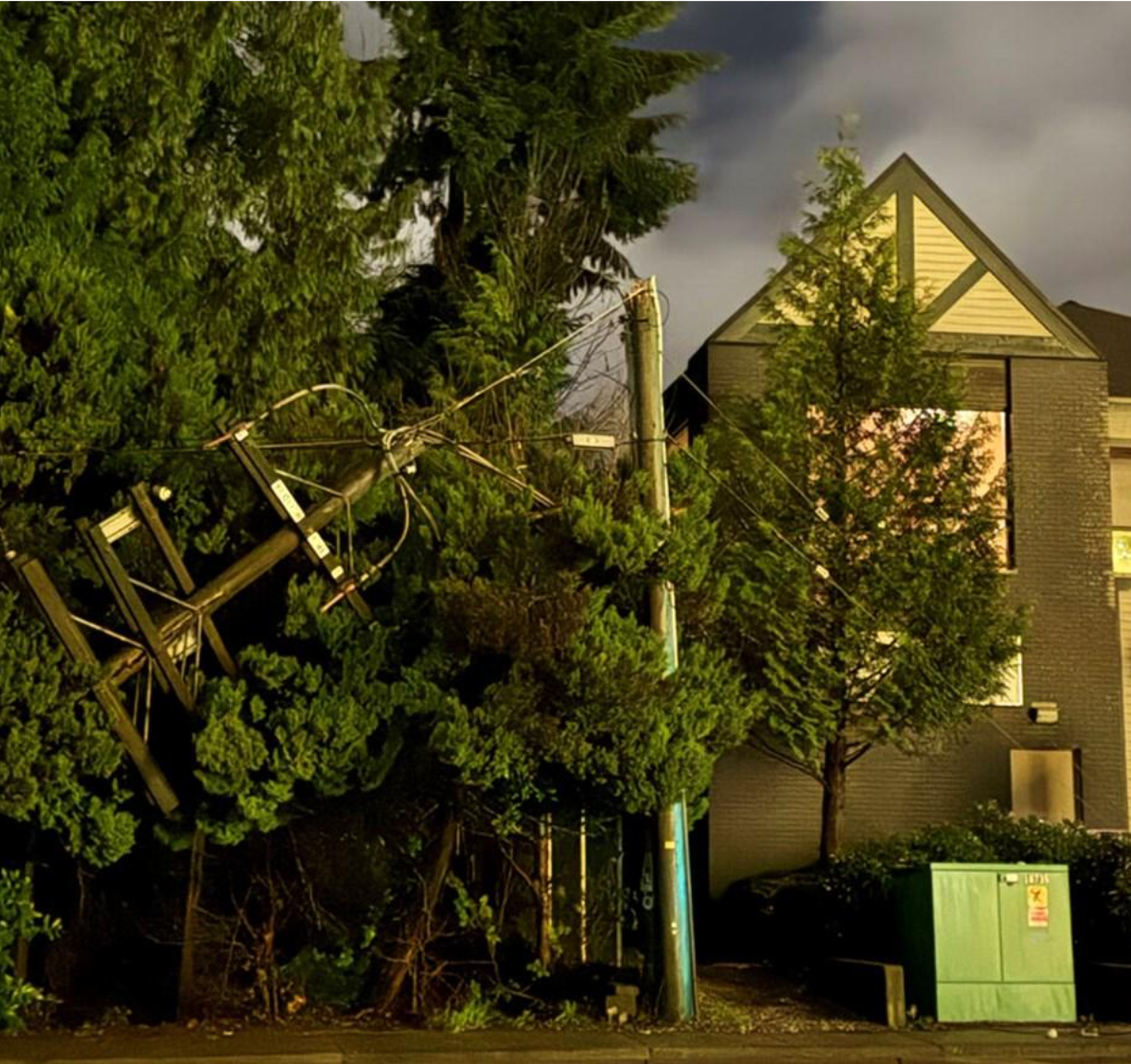
A snapped power pole on North Vancouver’s Mount Seymour Parkway near Parkgate Village in the early morning of Dec. 17, 2025 following a massive storm that ripped through the region. Photo, courtesy Karen Chernoff
When we were building our new all-electric house, my husband, Gordon, had the idea of getting a house battery for backup in case of power outages. Our old house had a wood fireplace in our living room that we could use for heat during blackouts, when the old gas furnace didn’t work, but the new house relies entirely on electricity.
We live in North Vancouver, where power outages are fairly common, especially during the fall and winter, when we get hit with heavy rainfall and strong winds. A December 2025 windstorm left roughly 10,000 customers on the North Shore without power. Another storm in November 2024 knocked out power for 29,000 homes in the area.
It turned out that getting a house battery not only provided the backup we wanted, but it also had a number of other advantages.
Our battery is connected to an emergency electrical panel. It’s not a whole-home backup, but it does allow us to use some of our devices: fridge-freezer, microwave, lights, and plugs in the office and kitchen. The battery stores 13.5 kWh (kilowatt-hours) of power; we did not completely drain it during any of the outages we experienced since moving into our house in 2023.
The switch to the emergency panel is seamless. When the power is knocked out, we notice a brief flickering of the lights and then the emergency panel is activated. We don’t have to do anything. Everything remains in place. And when the power comes back on, there is another brief flickering and conveniently everything goes back to normal—also without our intervention.
An added bonus: a secure island
In addition to being all-electric, our house has solar panels. You would think, in that case, a power outage would be no problem. After all, we can generate our own electricity. Why do we need a battery at all? Our solar panels are grid-tied. This means that when we generate more power than we need, we send it to the grid. And when we don’t generate enough, we get it from the grid. If you have a bi-directional system like this, and the grid power goes off, your solar panels will automatically shut down. This is due to a mandatory safety feature, designed to prevent them from sending power back into the grid and endangering utility workers repairing the lines.
However, if you add a battery and a transfer switch to the system, you can create a secure ‘island’ that allows the solar panels to power critical devices in the house and charge your battery without back-feeding the grid.
Are there ways to create a secure “island” that lets you run your solar system when the grid is down, without installing a battery? The short answer is yes. This video, Does Solar work during a Grid Outage? will give you an introduction to those options. There are solutions that are cheaper than house batteries, but they have disadvantages. For instance, there are inverters that, like a battery, can create a secure ‘island’, but they only work when it’s sunny.
Financial incentives
One day this January, a notification popped up on the app I use to monitor our electrical system. BC Hydro was interested in accessing our house battery from time to time. Our battery could become part of a virtual power plant that would help balance supply and demand in real-time, reducing the risk of blackouts during extreme weather or demand spikes. And by reducing peak demand, it would help to defer or eliminate the need for major investments in new transmission lines or substations. I liked the idea of contributing to the grid's resilience in our province. I also liked the financial incentive that BC Hydro was offering: $500 for signing on to the program and $250 a year for being a participant!
We signed up, and in February, BC Hydro accessed our battery on two occasions. Each event lasted 3 hours. In both cases, we received advance notice of these events. Kari Montrichard, Senior Manager, Capacity Products at BC Hydro, explained that mostly these events are foreseeable. “Our system operators are very sophisticated in looking at historical use. Usually, what drives us to call events is weather. BC Hydro is a winter-peaking utility, meaning on cold, dark winter nights when everybody's turning on heat and lights and doing laundry and cooking, we typically have constraints on our system.”
The BC Hydro virtual power plant program
BC Hydro conducted its first pilot project with batteries like ours in 2025. It supplied two communities, Sun Peaks near Kamloops and Harrison Mills in the Fraser Valley, with 200 batteries from Eguana Technologies, a Canadian company headquartered in Calgary.
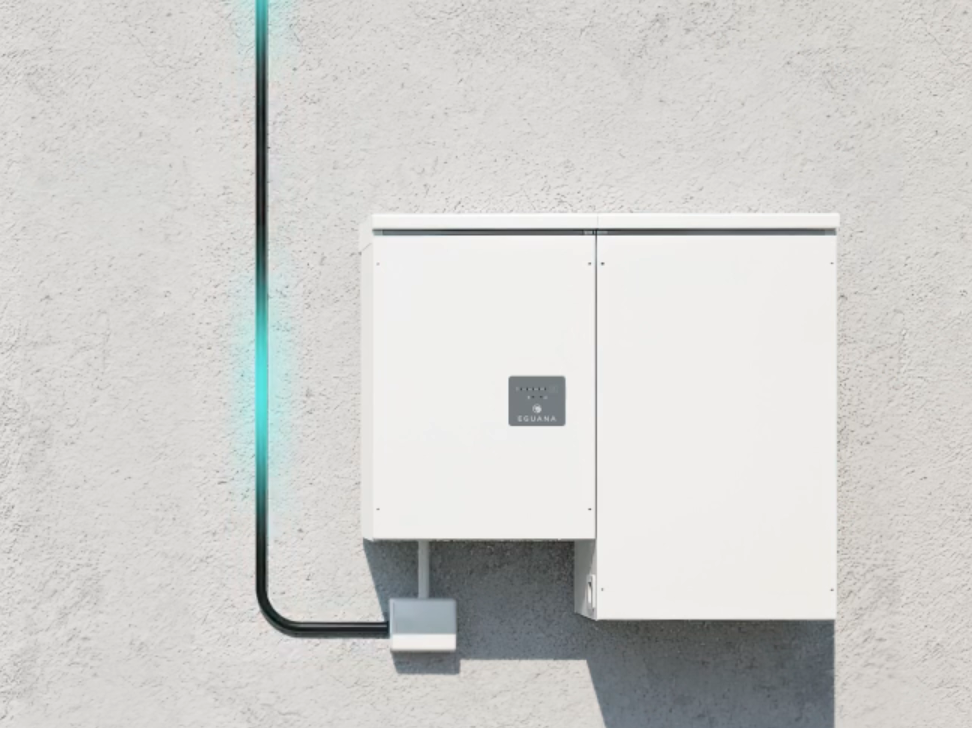
Here’s what the storage device looks like
Montrichard said BC Hydro undertook the project for two reasons: “First, to understand whether batteries can help support our customers through outages. What does that look like? How long can the batteries last, and what's the customer's experience around that? I would say there were some great learnings from both BC Hydro and the customer about how to install these batteries, how big they are, and how much of the load they can actually handle. We learned what you should connect. If you have a hot tub, that's not something to put on the battery because it's going to drain the battery pretty quickly. Secondly, we have some areas in our province where there's a growing demand and we are able to use those batteries to help manage demand when we need to from time to time.”
I asked Montrichard how our house battery, with its 13.5 KWh capacity, could possibly make a difference to BC Hydro. What we can contribute is not even a drop in the bucket! “It doesn't seem like a lot,” she admitted, “but if we had access to 5,000 batteries, then it multiplies, right? What my team's responsible for is getting all these different devices connected to this platform so we can use them. If everybody does a little bit, then it all adds up to a lot, right? So that's what we're trying to do here.”
The virtual power plant includes not only batteries but also other kinds of devices: thermostats, water heater controllers, and EV chargers. “We can aggregate all of those things,” Montrichard said, “and orchestrate them at different times when we might need them on our system. It could be across the entire system, or it could be in a localized area.” (If you are interested in having BC Hydro access a device of yours, check the BC Hydro website to see which devices and models are eligible.)
In our case, BC Hydro draws some of the power we store. What can it do with a thermostat? Montrichard explains: “We turn it down one to three degrees, depending on what the customer consents BC Hydro to do. Turning it down by a degree or two for four hours actually contributes to a one-kilowatt reduction. We have close to 800,000 homes that are electrically heated. If we get lots of those, that's going to help us out quite a bit.” So far, over 16,000 customers have signed up to allow BC Hydro to manage their devices when needed.
Time of day pricing
BC Hydro's time-of-day pricing is an optional, voluntary rate structure offering cheaper electricity overnight (11 p.m.–7 a.m.) and higher rates during the evening hours (4 p.m.–9 p.m.). It offers a 5-cent/kWh discount for late-night usage and a 5-cent/kWh surcharge during periods of high usage. Consumers who shift heavy-load activities, like EV charging, to the night can save money.
My husband and I signed up for time-of-day pricing, and we do shift some activities to the night—dishwashing and laundry, for example. We found, though, that because we have a battery and solar panels, we can often use electricity during the early evening hours without paying the higher rate for it.
This is possible on sunny days when our panels are generating a good amount of electricity. The screenshot on the left below shows a sunny day on March 14, when we generated a total of 22.9 kWh. As you can see, generation stops around 6 p.m. as evening falls. The screenshot on the right shows what is happening to the battery. The green strip near the bottom indicates it reached 100% charge around 4 p.m., just before the high-rate period begins. We can draw on that full battery for cooking—(a nice crusty focaccia, for dinner, say, at 400 F for half an hour). Later, when the sun is out again, the solar panels can recharge the battery. Or we can recharge from the grid, but in the middle of the night, when the electricity rates are low.
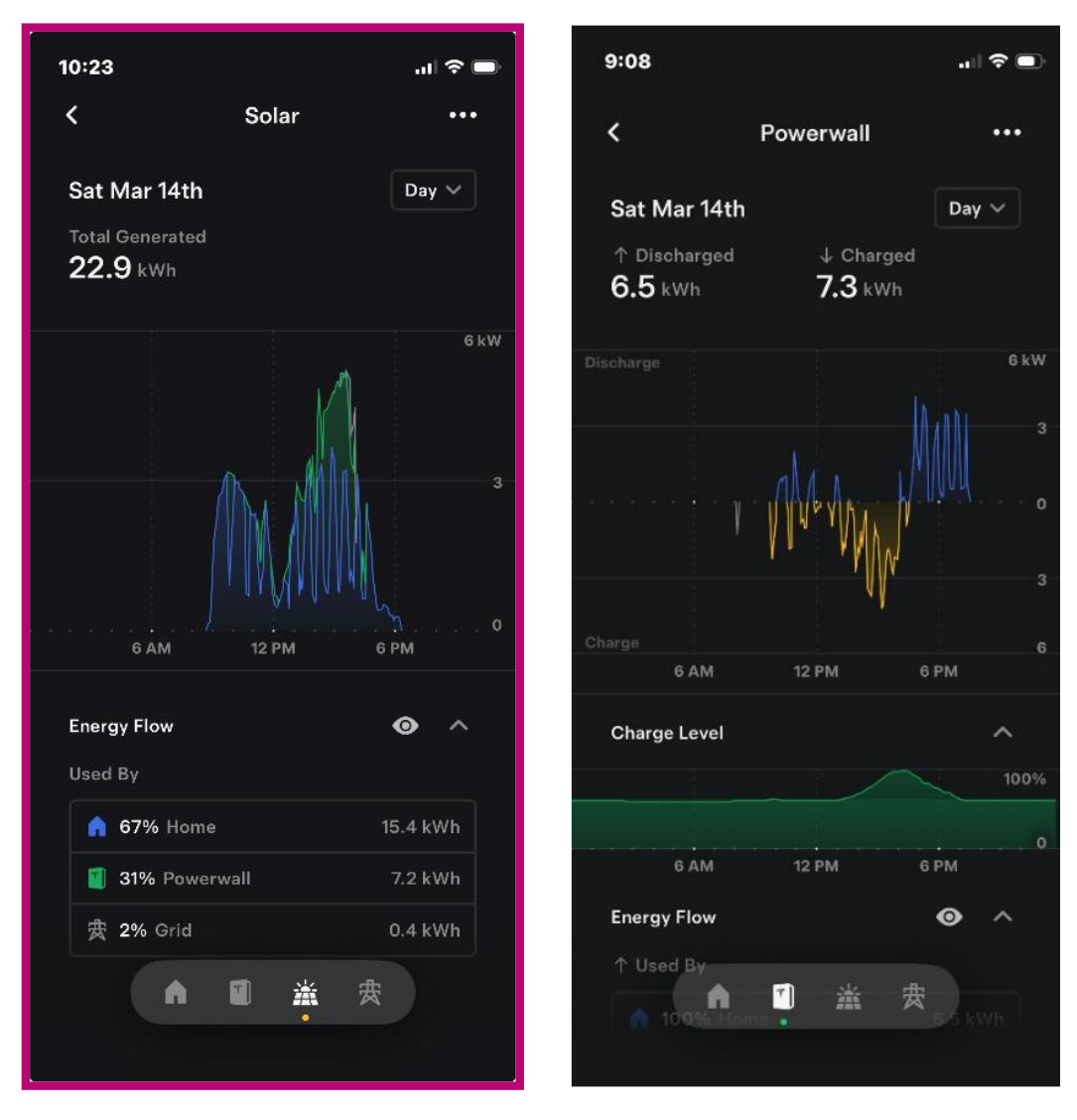
Generation until 6 p.m., Mar. 14 Full Battery at 4 p.m., Mar. 14
Demand flexibility
The Peak Saver Program allows customers to participate in reduction challenges during peak events—short periods when there’s a surge of demand on our grid. This is typically during very cold weather when electricity use is expected to be highest, but occasionally supports other needs, like temporary system maintenance. Montrichard explains, “We call on you from time to time. It's not something we're asking you to do every day. It's only through the winter season. And you get rewarded if you do reduce your electricity use. It's $3, but it can add up. In the winter, if we call 15 events, you might get $45 off your bill when the season's over.”
Currently, 185,000 residential customers and 1,500 businesses participate in the program. We’re enrolled in that program too, and so far in March, we have earned $9.
People who enroll in some of these new programs at BC Hydro help to create what Montrichard calls “demand flexibility,” the ability of homes, offices, and factories to shift and vary their electricity consumption to help balance the grid and keep the lights on. In BC, we now have about 85 megawatts of demand flexibility. A single megawatt powers about 1,000 homes in ideal conditions; so far, our demand flexibility of 85 MW can support a mid-sized city of roughly 85,000 homes, the size of Richmond. Montrichard said, “We hope to grow that over time to have even more megawatts that our system operators could use to manage our system.”
Enter ‘prosumers’
What we are seeing is the development of an electricity system that is much more flexible, efficient and reliable than in the past. It includes self-producers, called prosumers: a neologism combining the words “producer” and “consumer.” The American sociologist Alvin Toffler coined the term in 1980 in his book "The Third Wave." Two Canadians, the philosopher, Marshall McLuhan, and the engineer, Barrington Nevitt, first suggested the idea in their book, Take Today: The Executive as Dropout, published in 1972. They argued that we were entering a new age in which consumers could produce electricity as well as use it.
The prosumer paradigm
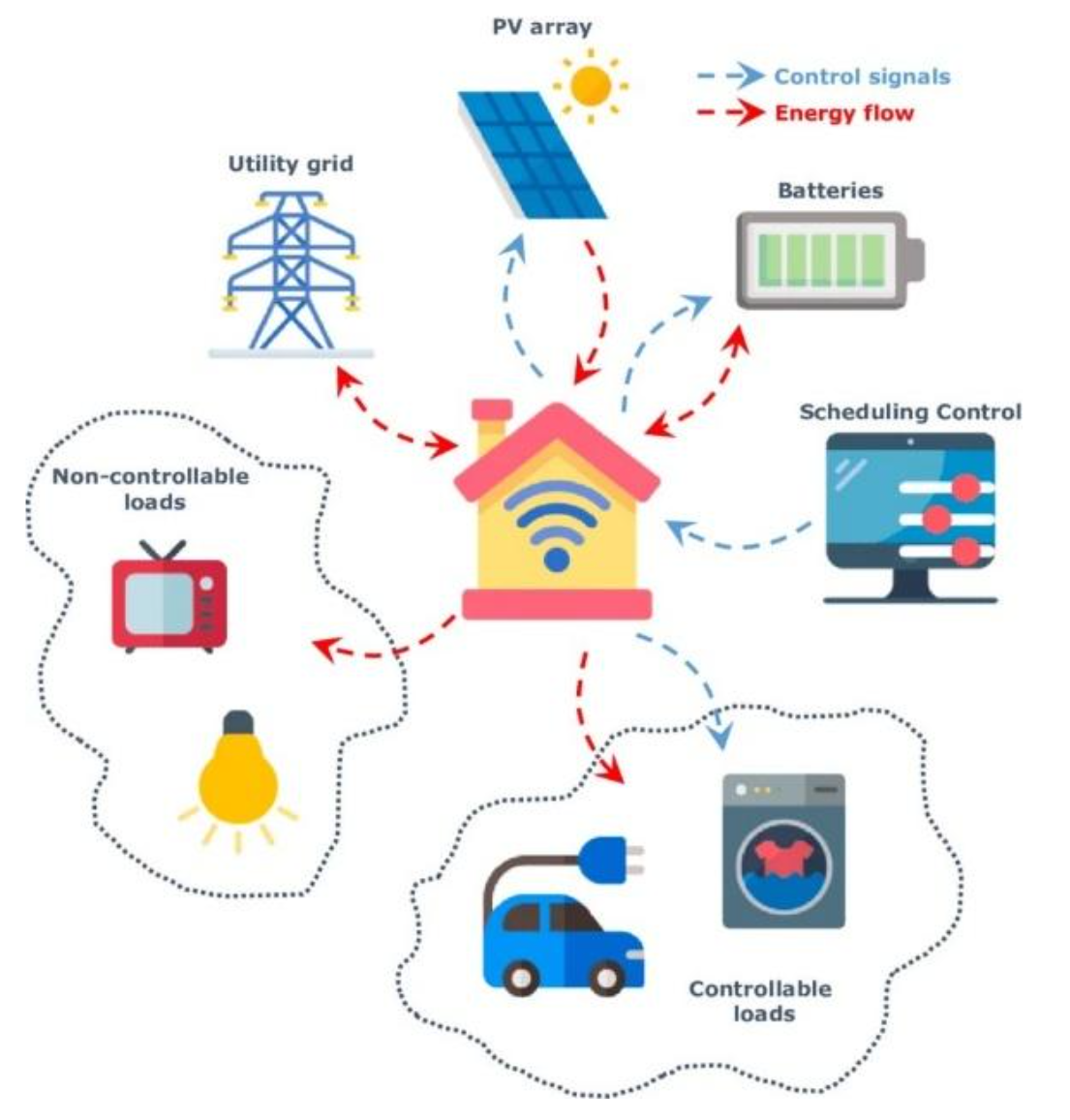
An illustration of the consumer-prosumer paradigm from Marcos Tostado-Veliz, “A MILP framework for electricity tariff-choosing decision process in smart homes considering ‘Happy Hours’ tariffs,” International Journal of Electrical Power and Energy Systems.
The grid is no longer a one-directional system, in which power generation and storage is centralized, perhaps at a great distance from its customers. Prosumers produce energy at home and sometimes send it back to the grid. Those consumers who don’t produce electricity also benefit from recent innovations. They can have much more control over their usage than before, when it takes place and how much they are billed for.
We are all becoming empowered! Haha.
Moving towards prosumer electrification globally
A 2024 report by Statistics Canada, called Assessing the Photovoltaic Potential of the Canadian Building Stock, concludes that in Canada, “rooftop PV, on residential buildings can supply as much electricity per year as is consumed in these buildings.” The BBC has reported that the UK is establishing new rules to ensure that virtually all new homes will have solar panels and heat pumps. Plug-in panels that homeowners can self-install on balconies will soon be readily available.
British Energy Secretary Ed Miliband explains why these developments are essential: “The Iran war has once again shown our drive for clean power is essential for our energy security, so we can escape the grip of fossil fuel markets we don't control.”
If this story resonates with you, please forward this to a few friends and suggest they join our email list. We're building a group of like-minded people who want to see the North Shore positively embrace and manage the many changes we face. Thanks, we really appreciate it.