Who’s running, and whoa, why are there so many candidates?
Nominations are closed, and the final list is out. Shore-wide totals: 64 candidates, 13 for mayor and 51 for 18 council seats. The District of North Vancouver is host to the most mayoral contenders with five candidates. The City of North Vancouver and West Van are tied at 18 council candidates for six council seats. In West Vancouver, two council seats are open (Sharon Thompson is running for Mayor, and Nora Gambioli has stepped down). No other seats are open in any of the shore munis. Since incumbents almost always are returned (between 80- and 90% of the time), why are so many hopefuls running?
What does it mean?
I dunno. Usually, when more people get involved in something, it means interest has increased. Well, that’s obvious. But why more interest this time? Is it pay parking, the wastewater treatment plant fiasco, the lack of affordable housing? Are there more millennials running on the premise that they would like to see change to policies that have not helped their generation? We’ll follow the campaigns and report what we see developing over the next six weeks.
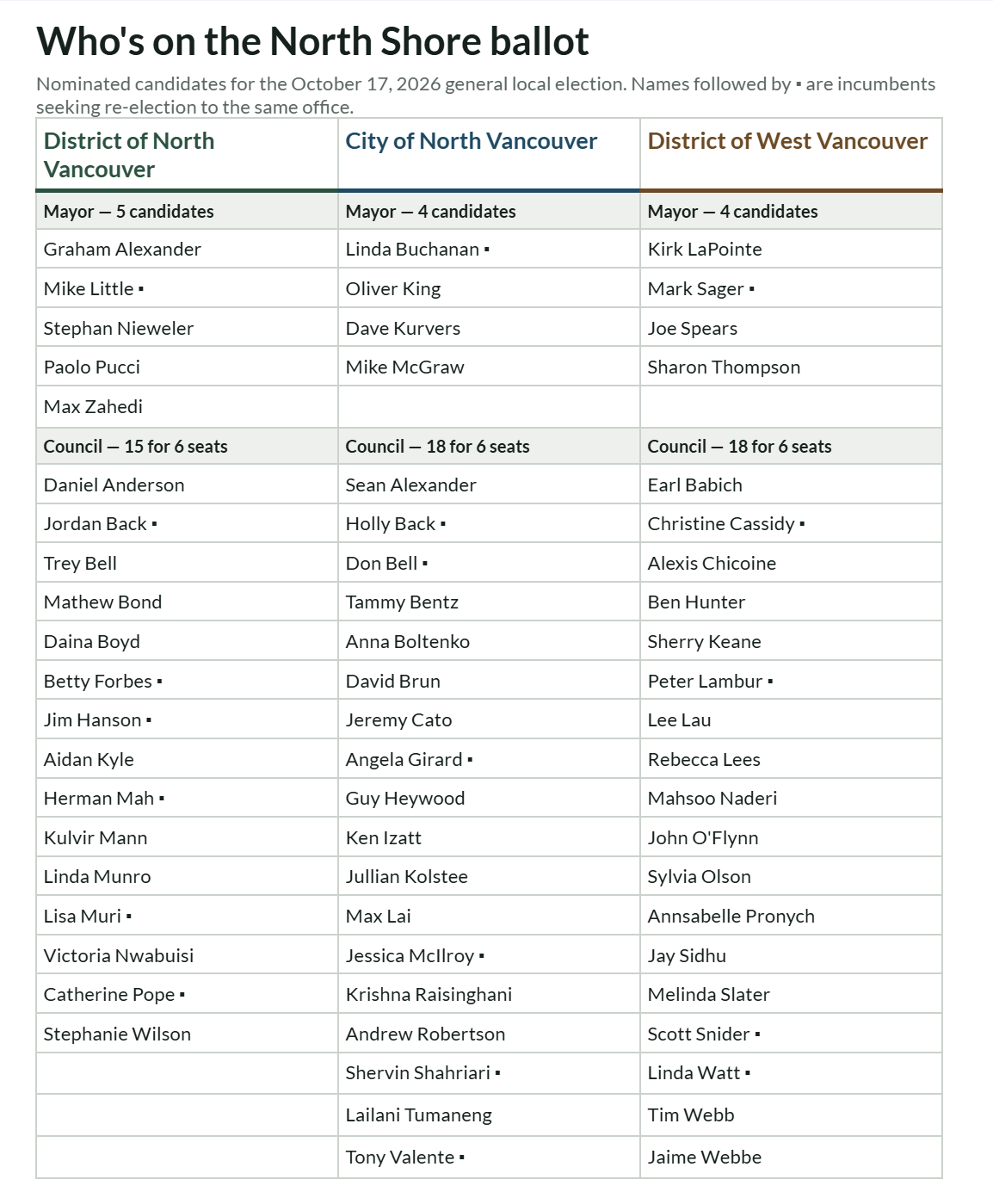
I asked Claude to look at as many candidate sites as he could and return the top issue for each of the three munis - here’s what he found among the sites that are up as of today.
Top issue in the District of North Vancouver?
Traffic, congestion and the bridge
Transportation is the most universal issue on DNV candidate sites.
The split is in how candidates would deal with traffic. The build-more-road-capacity camp: Hanson wants a third southbound lane on the cut between Lynn Valley Road and Mountain Highway plus provincial investment in rapid transit, and Forbes wants a third crossing, highway lanes from Lonsdale to Mountain Highway, and a lane reconfiguration on Mountain Highway, alongside safe active transportation routes. The transit-and-crossing camp: Back makes replacement of the Ironworkers Memorial Bridge his headline transportation ask and says he opposed costly road projects that would damage green space without solving congestion, Pope wants a new bridge with SkyTrain plus east-west connection improvements, and Wilson argues the District cannot pave its way out and focuses on RapidBus and bus rapid transit expansion, service to underserved neighbourhoods, and active transportation.
Top issue in the District of West Vancouver?
Property taxes and the North Shore Wastewater Treatment Plant
This is on every single site I reached, and it's the one issue where the language gets sharp rather than aspirational. Lambur calls West Vancouver's share of the plant's cost "unprecedented and unacceptable" and notes he seconded the July 20, 2026 motion asking the Inspector of Municipalities for a Section 765 inquiry into the cost increases and delays. Linda Watt devotes a full homepage section to having led the push for that inquiry and securing unanimous Council support for it. Sager claims the inquiry motion as his own, pointing to a flawed 2013 budget and governance structure and arguing today's officials inherited decisions made more than a decade ago. LaPointe turns the same material outward, listing stronger accountability at Metro Vancouver among his five commitments. Below that, generic tax discipline is near-universal — Olson goes furthest with an explicit "zero property tax increases" plank, while Sidhu is the only one to reframe it as a revenue problem, noting 97% of income comes from property taxes and calling for more diversified income streams plus honest conversations about what could be cut.
Top Issue in the City of North Vancouver?
Housing and how the city grows
Housing appears on every site, but it's also where candidates diverge most sharply. On the supply side: Robertson's entire frame is a housing shortage that produces "the wrong homes," with missing middle, non-market expansion, community land trusts and renter protections; Valente points to the largest rental increase since the 1970s and commits to co-op, social, co-housing and workforce housing; Lai proposes raising inclusionary requirements to 30% and a workforce housing program targeting $30–80K earners; Raisinghani names secured rental, three-bedroom family homes and essential worker housing with measurable targets. On the constraint side, the same word means something different: McGraw's example is the 21-storey tower approved on East 14th where the community plan caps height at 6 to 8 storeys, and Izatt's housing plank is almost entirely preservationist — a binding tenant relocation bylaw and tax exemptions to stop demolition of older rental stock. Notably, tenant protection shows up on both sides — Izatt, Robertson, Raisinghani, Valente and Shahriari all commit to it.
Community events
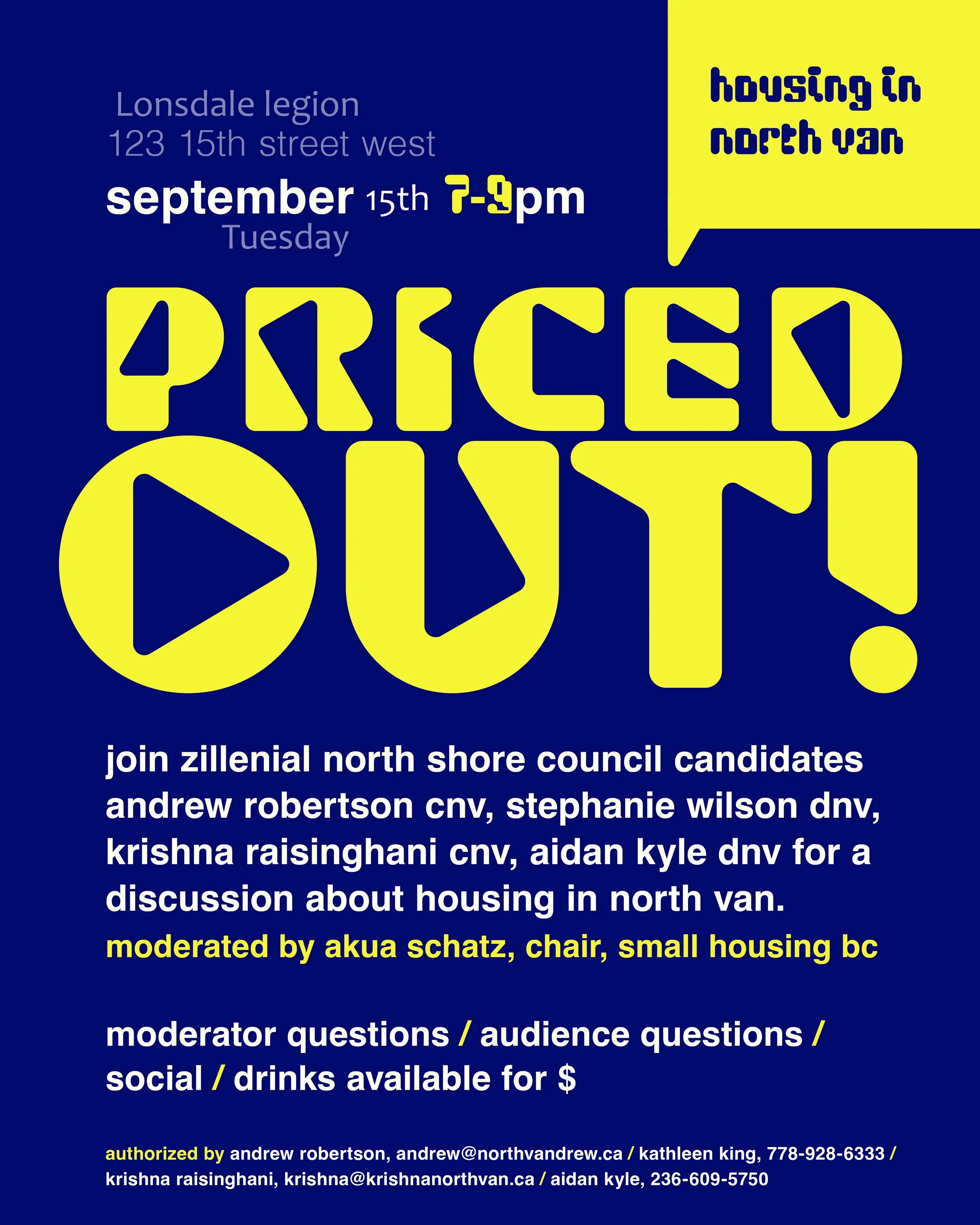
Registration is not required.
Tired of election talk? Take a break and get the kids out tomorrow!


Better North Shore — Chat Server
Join the conversation on Discord. We talk about housing, transit, cycling, municipal politics, and everything North Shore. 👉 Join the BNS Discord