Seven reasons why multiplexes create more affordable homes
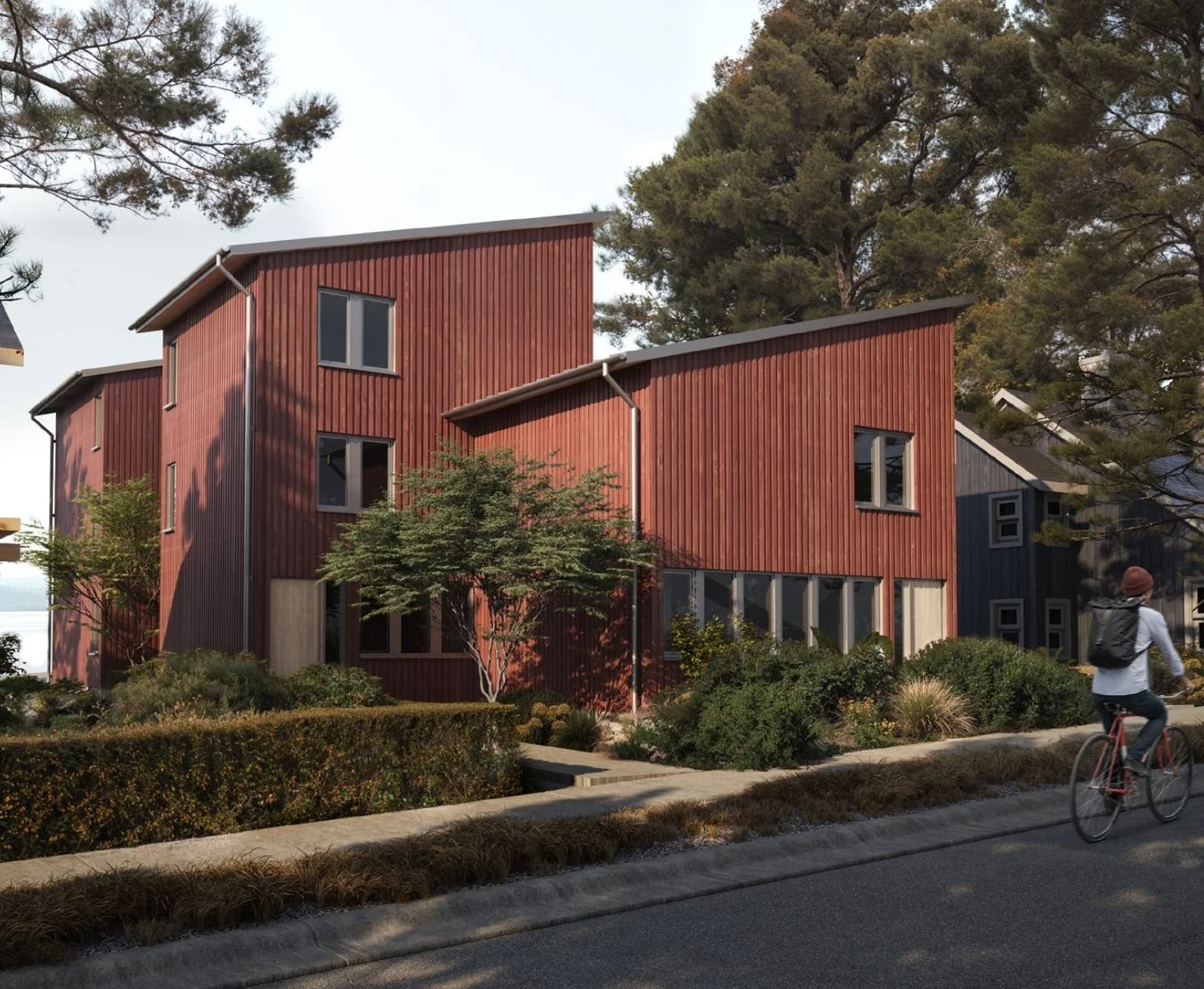
This four-plex fits on one single family lot, providing living spaces for more people at lower cost than a single family home. Image: B.C. Standardized Housing Designs Catalogue
In low-density neighbourhoods, multiplexes represent a transformative approach to housing affordability and diversity. They share the high cost of land while offering smaller, more affordable units, increasing overall housing supply. More access to the underlying land benefits a broad range of income levels for both homeownership and rentals. Additionally, multiplexes help reduce upward pressure on housing prices and create varied living options for families, seniors, and younger residents. By shifting the focus from luxury homes, multiplexes foster thriving communities with young and old able to afford to live here. As the Shore embraces them, we can expect a more inclusive and sustainable housing landscape that provides more affordable homes in every neighbourhood.
1. Land Cost Is Shared Across More Homes
On a single-family lot, one household carries the full land cost.
On a 4-plex or 6-plex, that same land cost is divided among multiple units.
Example: If a lot costs $1.6M, a single detached house buyer must carry all $1.6M.
If six units share that cost, each carries about $266K of land value instead of $1.6M.
This is the single most significant driver of lower per-unit cost.
2. Smaller Units = Lower Total Price
Multiplex homes are typically:
Smaller than new detached homes
Much cheaper to build (e.g., no basement excavation for a mansion, smaller building envelope)
A new detached house in DNV might sell for $2.5–3.5M.
A multiplex unit is often $800K–$1.2M depending on size—still expensive, but much more attainable than a detached home.
3. More Supply = Less Upward Pressure on Prices
Even modest increases in gentle density:
Add “missing middle” homes targeted to households earning normal incomes
Reduce competition for older rentals
Slow price acceleration at the neighbourhood level
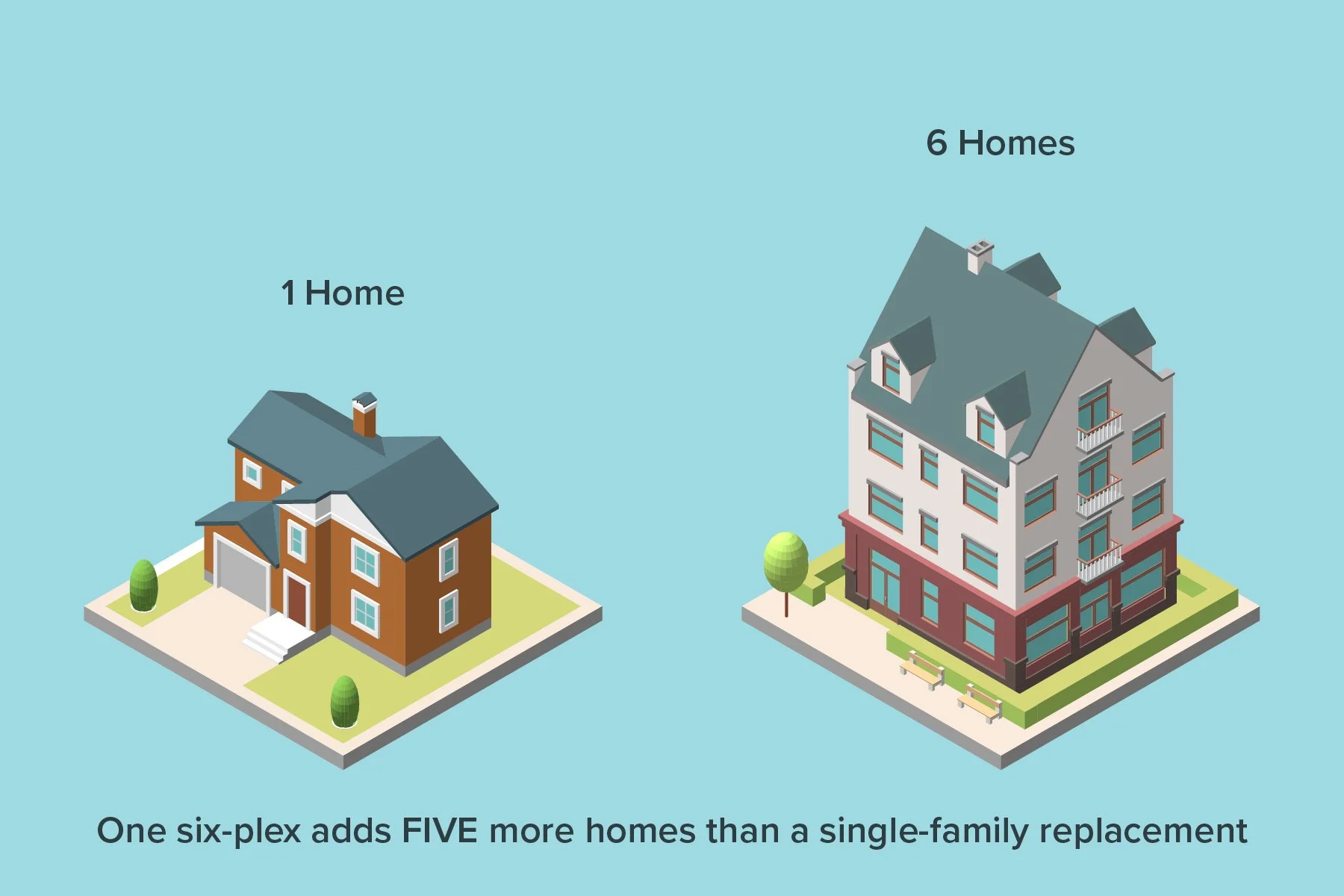
One 6-plex adds five more homes than a single-family replacement. If done repeatedly across neighbourhoods, this meaningfully increases supply.
4. Cheaper to Rent Because Land Cost per Door Is Lower
For renters:
A secondary suite or multiplex rental unit priced at $2,000–$2,800/month is significantly cheaper than renting an entire detached home for $5,000–$7,000/month.
Purpose-built multiplex rentals can be 20–30% cheaper than units in 6–12-storey concrete apartments due to lower construction costs (wood frame vs. concrete).
5. Multiplexes Unlock New Ownership Forms
Cities are starting to see:
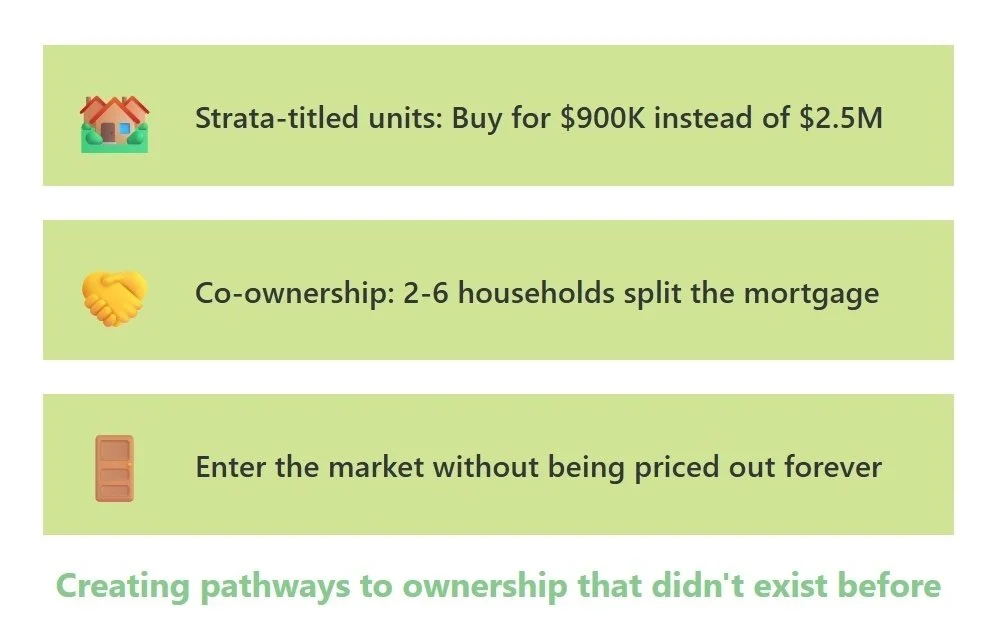
Strata-titled multiplex units (e.g., someone buys a 3-bed unit for $900k instead of a $2.5M house)
Co-ownership models, where 2–6 households split the mortgage and own separate units
This lets buyers enter the market who otherwise would be permanently priced out.
6. Aging Neighbourhoods Get More Diverse Housing Options
Multiplexes create:
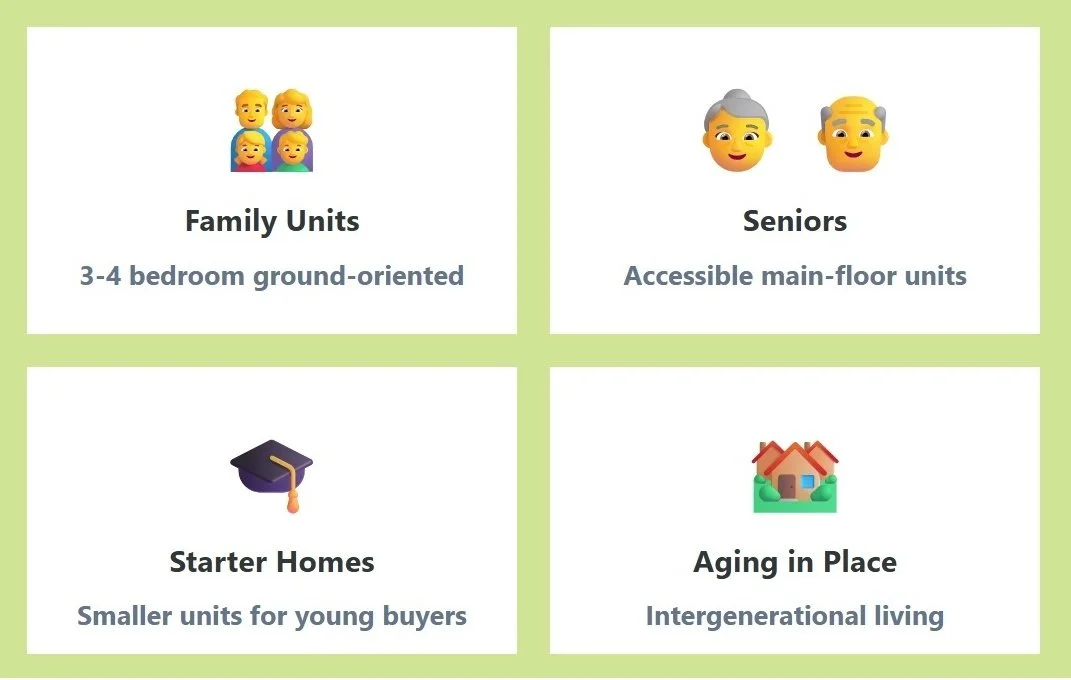
Ground-oriented family units (3-bed, 4-bed)
Accessible main-floor units for seniors
Smaller “starter homes” for younger residents
This supports aging in place, intergenerational living, and a broader mix of incomes.
7. They Prevent Land From Being Used Only for Luxury Homes
Without multiplex zoning:
Developers typically tear down an older house and build a large $3–4M detached home.
That replacement does nothing for affordability.
With multiplex zoning:
The redevelopment instead produces 4–6 more attainable homes, often with at least one rental unit.
Multiplexes are the simplest and most effective way to create attainable ownership and more rental options in low-density neighbourhoods. Multiplexes make homes more affordable by spreading the land cost across several households, producing smaller, lower-cost units, and adding supply to the ground-oriented part of the housing market.
If this story resonates with you, please forward this to a few friends, and suggest they join our email list. We're building a group of like-minded people who want to see the North Shore positively embrace and manage the many changes we face. Thanks, we really appreciate it.
Take Action - Email council
If you want to effect real change, you can start with an email to one of: council@dnv.org , citycouncil@cnv.org, or correspondence@westvancouver.ca - an email to your municipal council doesn’t have to be long, nor formal. You can write at any time to express your support for more affordable homes in every neighbourhood, - for more, and more frequent - transit, or any of the issues you are challenged by. Tell them Better North Shore sent you.