

A Better House: Our journey to a passive home
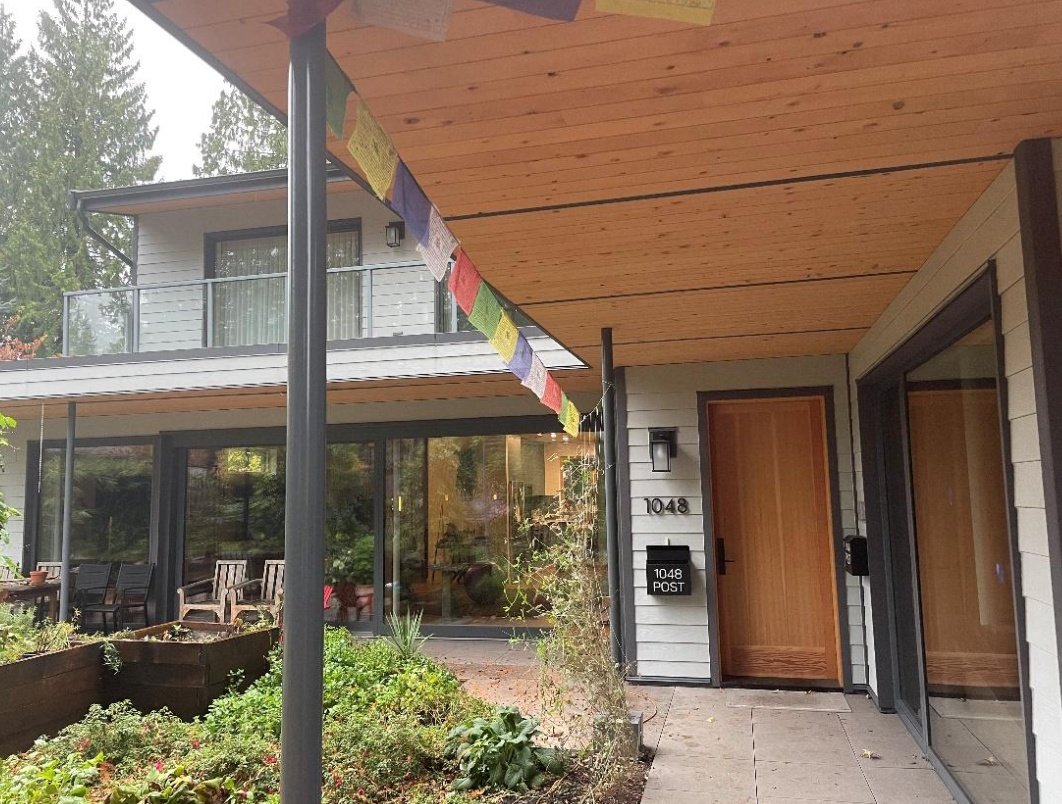
Our new passive house re-uses the yellow cedar from the original bungalow
For a long time, my husband, Gordon Cornwall, and I dreamed of a home that would minimize energy consumption. We lived in a bungalow in North Vancouver that was built in 1959. It was charming, post-and-beam, mid-century modern. But it had many flaws: single-glazed windows, a cracked slab, and poor insulation. It had moisture issues, and we routinely scraped black mould off the window frames. We decided to deconstruct our old home and build a new one on the same site. We engaged EconGroup to both design and build a passive house.
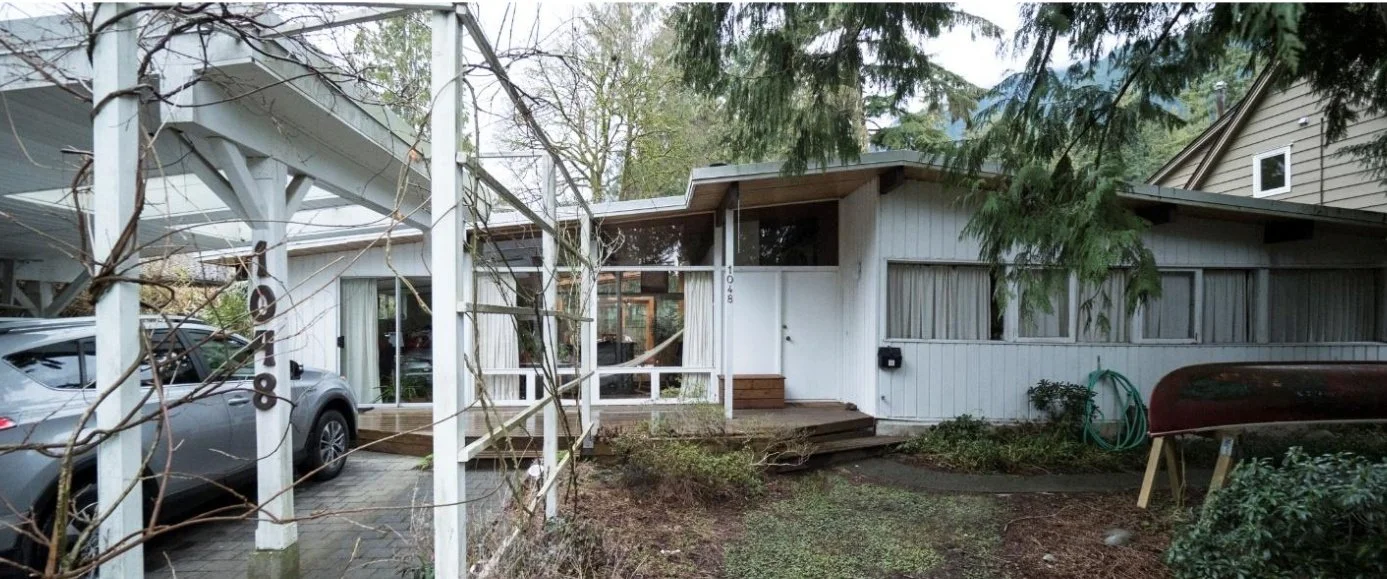
Our original house was charming, but had a few flaws…
We saved the yellow cedar from our old place and used it to clad our ceilings downstairs and the soffits. Because we now had more space, we also included a legal suite. We were happy to contribute in this small way to the District of North Vancouver’s Official Community Plan which identified increased density as a goal. We also tried to keep as many plants and trees as we could—a lovely wisteria, a rhododendron, a camelia, a large Western maple and a quartet of red cedars, over 65 years old.
We moved into our new home on Earth Day in April 2023.
A plaque next to our front door reads “Certified Passive House.” Highly efficient, our home has premium insulation, airtight construction, triple-glazed windows, and controlled ventilation.
The building technology was developed in Canada by engineer Harold Orr in Saskatchewan in 1977. Then the world faced oil shortages and oil prices were skyrocketing. The Saskatchewan government asked its Research Council to design a house suitable for Saskatchewan that would minimize energy use. The result was the Saskatchewan Conservation House, built in Regina—at the time, the world’s most airtight house. It used 85% less energy than the average 1970’s home. In 2015, Orr received a Pioneer Award at the International Passive House Conference, for being a trail-blazer. In Canada, his house led to improved insulation, better windows and doors and R-2000 homes.
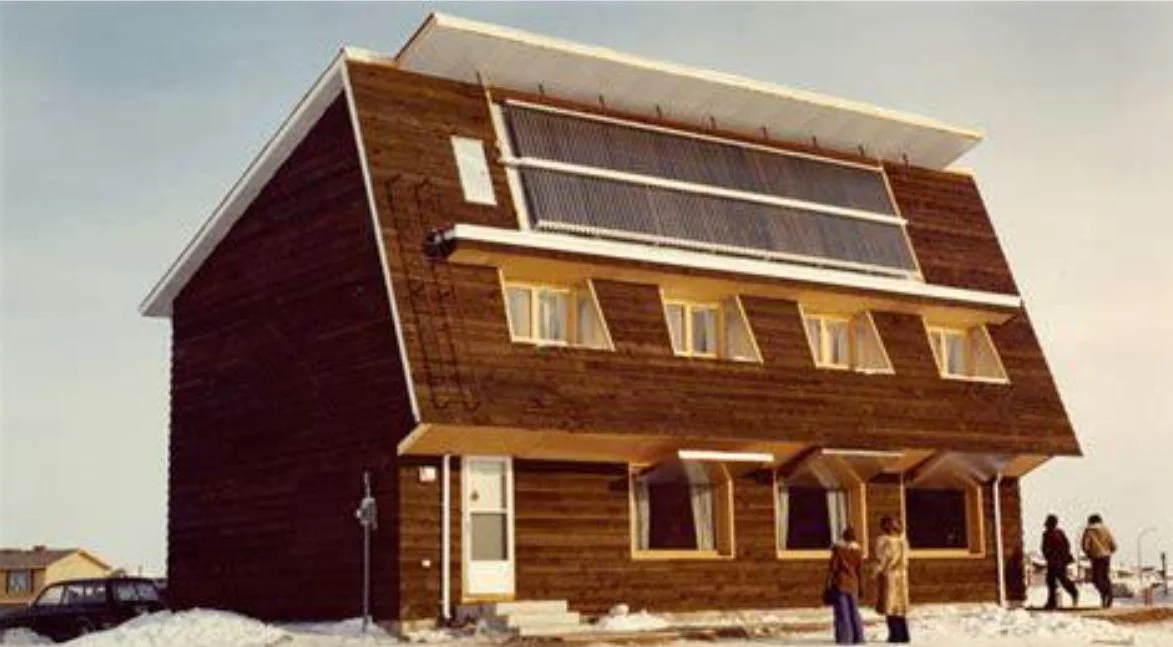
Saskatchewan Conservation House, built in 1977
The Conservation House attracted many visitors, including a group of German engineers who took the idea back to Germany, where it became quite popular. (Thus, Germany often gets credit for having originated the concept.) Today in Heidelburg, in a new neighbourhood called Bahnstadt, all the buildings are passive construction. The district has 6,000 residents and another 6,000 people work there.
What is it like to live in a passive home?
Not only do we have insulation in the walls and under the roof, as conventional homes do, but also under the slab.
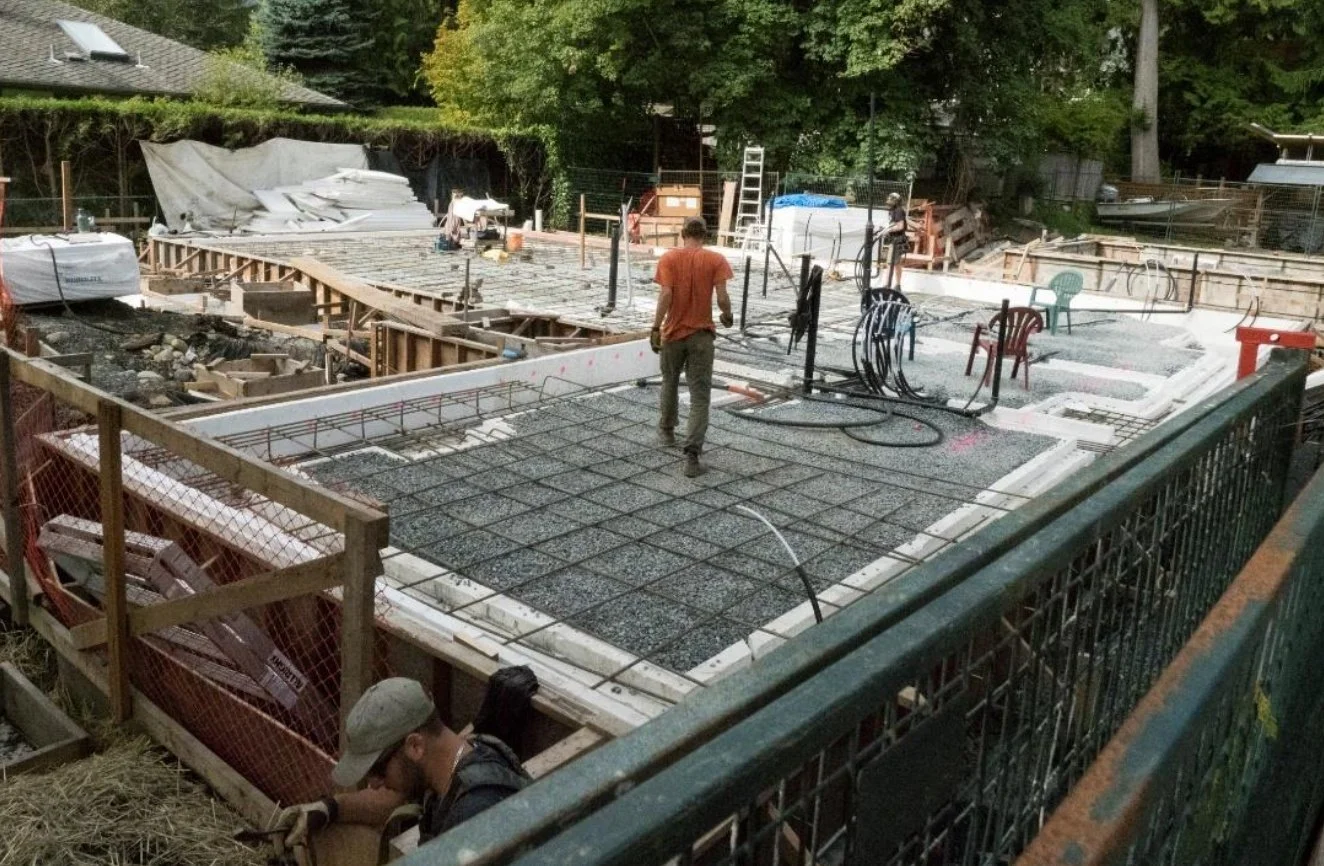
Under construction: First a thick layer of drainage gravel, then insulation (6-inch high-density Expanded Polystyrene), another layer of gravel, and rebar. The next layer was the slab (made of low-carbon concrete).
Our moisture issues are a thing of the past. Thick walls buffer us from cold and heat and mute sound. We don’t hear traffic, sirens, or dogs barking. Overnight guests often comment on how well they sleep.
The inside air is always fresh. There is very little dust. Our ventilation system relies on Zehnder filters, one fine and one coarse. We also have a carbon filter to keep out particulate matter. We only use it when smoke is a risk. The system has two parts: one for the suite and another for the rest of the house. Our two households don’t share the air. If my husband or I get an infection, our tenant doesn’t have to worry about catching it. And we don’t have to worry about coming down with something that she might have either. (Learn more on the topic of inside air.)
Our house makes use of solar-gain and shade. Summer or winter, we are mostly around 20 to 21 degrees; there are no cold spots. In the summer, when the sun is high in the sky, our large overhangs shade the house to keep it cool. In the winter, when the sun is low, the rays come into the house and help warm it.
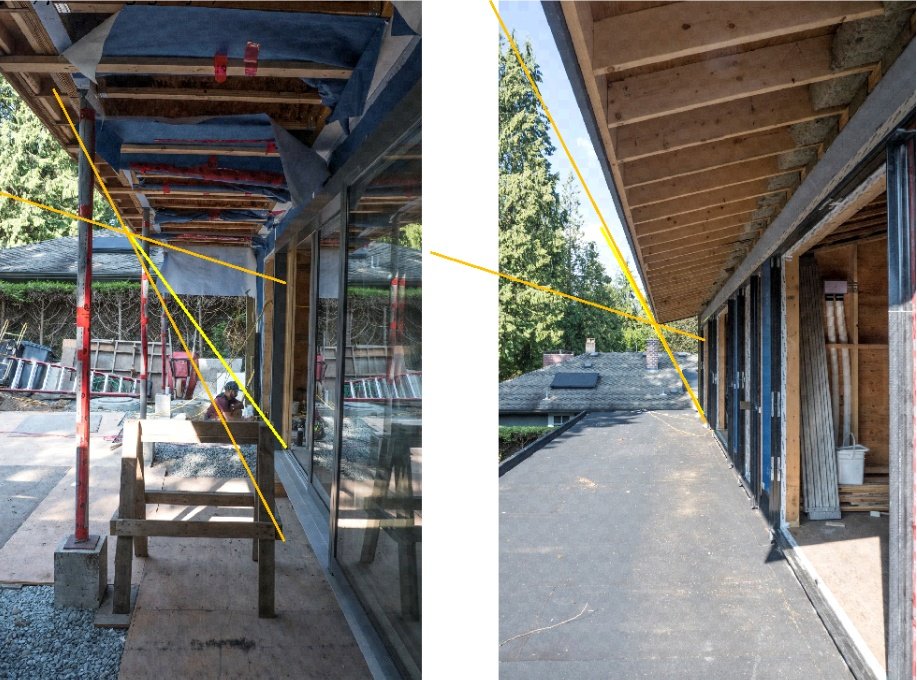
The new overhang angle enables solar gain and provides shade
Our ventilation system is also a heat recovery system. In winter, pipes bringing the cool outdoor air in are warmed by pipes carrying stale warm air out. In summer, the reverse is true. Warm air coming in is cooled by the air going out. We have two heat pumps, one for space heating and cooling and one for domestic hot water. We have a house battery for backup during power outages.
To be certified passive, our house had to meet certain standards. The total energy used in a home for space heating, cooling, hot water, lighting, appliances etc. can’t exceed 60 kilowatt hours per square meter of living space per year. Our house is 290 square meters (3,120 square feet) and thus has a limit of 17.4 megawatt-hours per year. We used 13.5 MWh to meet all our energy needs in 2024, meeting the requirement quite easily.
Passive buildings are very airtight and should have no more than 0.6 air changes per hour at 50 pascals of pressure. The blower door test found we had 0.36 air changes per hour. Again, we cleared the bar with ease.
According to Statistics Canada, in 2021, the average household in a single detached home in Canada needed 108.7 gigajoules for its energy, from all sources, gas, oil, electricity, and wood. Using only electricity, our place serves two households and consumes 48.6 gigajoules of energy, 55% less than the average.
Passive house technology is quite adaptable. It can be used for detached homes such as ours, as well as for multiplexes like The Narrows, a six-floor, 48-unit building recently constructed at Hastings and Cassiar. The final result requires 90% less energy than conventional construction.
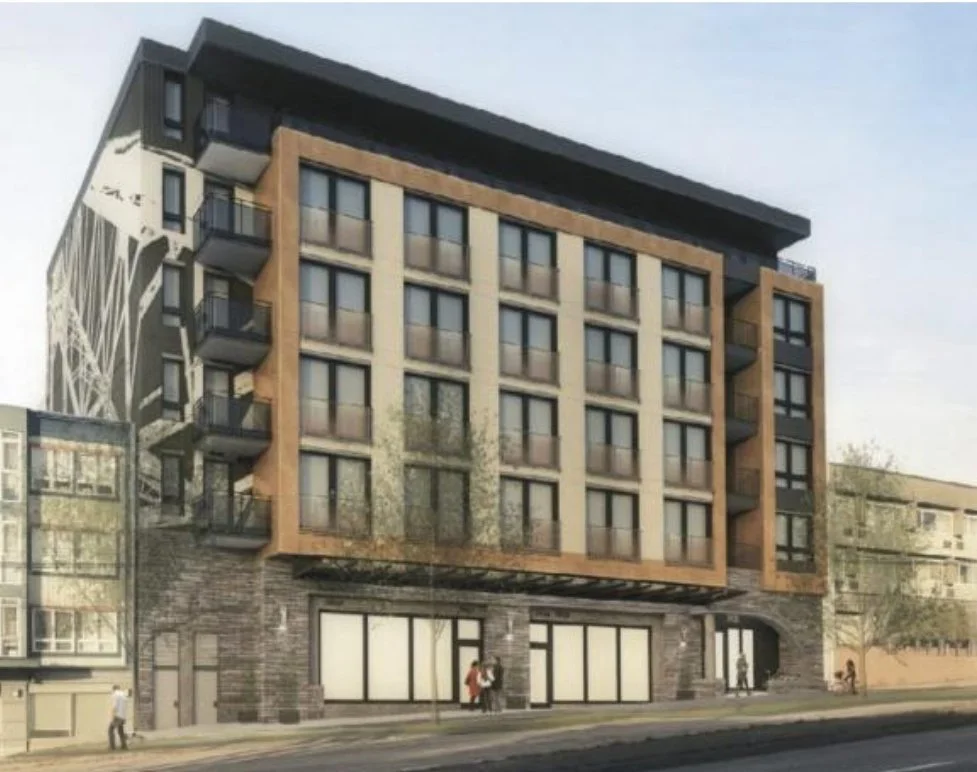
The Narrows was built to the passive house standard, near the Vancouver-Burnaby boundary.
We took one further step. We installed solar panels to produce electricity. Our aim was not just to have a passive, low-energy house, but to generate on-site electricity for our own use and to export to BC Hydro.
How did we do on that score? See the next installment for that story.
This article is part our A Better House series:
If this story resonates with you, please forward this to a few friends, and suggest they join our email list. We're building a group of like-minded people who want to see the North Shore positively embrace and manage the many changes we face. Thanks, we really appreciate it.
Take Action - Email council
If you want to effect real change, you can start with an email to one of: council@dnv.org , citycouncil@cnv.org, or correspondence@westvancouver.ca - an email to your municipal council doesn’t have to be long, nor formal. You can write at any time to express your support for more affordable homes in every neighbourhood, - more, and more frequent transit, and real traffic improvements - or any of the issues you are challenged by. Tell them Better North Shore sent you.